
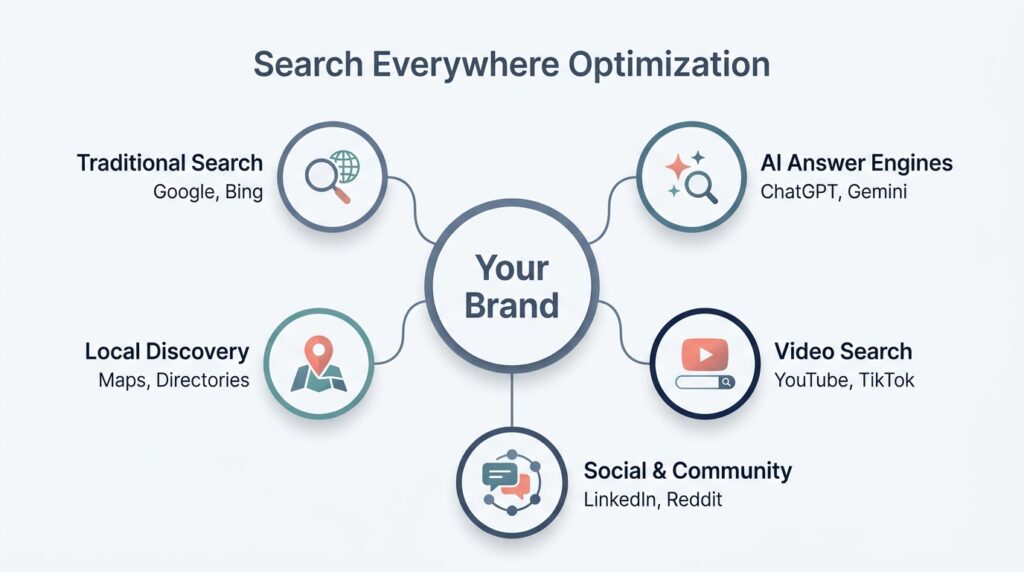
What Is Search Everywhere Optimization and How Modern Search Works
Search Everywhere Optimization is the practice of building your brand visibility and credibility across all the digital platforms where people search for answers. Instead of relying on Google rankings alone, this approach connects traditional web search with AI answer engines, video channels, social platforms, and review directories. The goal is to ensure buyers find clear, trustworthy information about your business at every stage of their research.
For over two decades, search marketing meant optimizing web pages to win clicks from ten blue links. Today, people start their research inside conversational AI tools, watch practical demonstrations on YouTube or TikTok, and verify peer opinions on Reddit before ever visiting a company website.
This guide explains how modern discovery works and why buyer research habits have fragmented across multiple platforms. You will also learn how different search algorithms evaluate content and how to build a practical multi-platform strategy without overwhelming your team.
How Traditional Search Evolved Into Search Everywhere Optimization
Traditional search engines remain the largest discovery channel on the internet. According to Search Engine Land, roughly 73% of search intent still revolves around Google, while the remaining 27% is distributed across more than 40 other platforms. That 27% represents the fastest-growing shift in consumer discovery behavior.
At the same time, the way Google presents results has changed dramatically. A June 2026 study by SparkToro found that 68% of Google searches now end without a click to an external website, up from 45% a decade ago. Because search results now deliver instant summaries and embedded videos directly on the page, ranking a single blog post is no longer enough to capture buyer attention.
Understanding how SEO works in 2026 requires treating your website as your central source of truth while extending your presence to the external platforms where buyers validate their choices.
How SEO AEO and GEO Fit Together
Marketers often use several acronyms to describe modern search visibility. Rather than competing with one another, these approaches work together as connected layers within a single discovery ecosystem.
| Optimization Approach | Primary Focus | Core Discovery Surfaces | Main Success Signal |
|---|---|---|---|
| Traditional SEO | Improving technical site health, page relevance, and organic rankings in web search engines | Google Search and Bing | Organic rankings, impressions, and qualified website visits |
| Answer Engine Optimization | Structuring page content to provide direct, concise answers to specific user questions | Featured snippets, voice assistants, and People Also Ask boxes | Direct answer extraction and zero-click brand visibility |
| Generative Engine Optimization | Building brand entity clarity and third-party proof so AI models reference your business | ChatGPT, Perplexity, Gemini, and Google AI Overviews | Brand mentions, source citations, and AI referral traffic |
| Search Everywhere Optimization | Unifying web search, AI answers, video, social discovery, and reviews into one strategy | Search engines, AI tools, YouTube, TikTok, LinkedIn, Reddit, and Maps | Cross-platform discoverability, branded searches, and pipeline growth |
When you structure content for Answer Engine Optimization, you make it easy for algorithms to extract clear definitions and steps. When you apply Generative Engine Optimization, you help large language models verify your authority across the web. Search Everywhere Optimization brings all of these disciplines together alongside video and community platforms.
Why Buyers Cross Check Multiple Platforms Before Making a Decision
People rarely discover a company on one platform and buy immediately. Instead, modern buyers move back and forth across several channels to confirm that a business is legitimate and capable of solving their problem.
The Psychology of Multi Platform Research
The drive to check multiple platforms comes down to human psychology and risk reduction. Behavioral research cited in Semrush shows that buyers feel the pain of a bad purchasing decision twice as intensely as the benefit of a good one. As the price or complexity of a product increases, buyers invest far more time into cross-checking claims.
Someone buying a low-cost everyday item might run a single search and purchase within minutes. In contrast, a business owner evaluating a high-value software platform or agency partner often checks 20 or more digital touchpoints over several weeks. They use each platform to eliminate a specific doubt about performance, cost, or reliability.
Even when users see an AI summary on Google, their verification journey continues. According to an April 2026 study by Seer Interactive, comparison and question queries trigger AI Overviews on more than 85% of informational searches, and brands cited directly inside those AI Overviews earn 120% more organic clicks per impression than brands left out.
How the Customer Journey Moves Across Digital Touchpoints
Consider how a company founder typically researches a B2B service provider today. First, they ask ChatGPT or Perplexity to explain their core bottleneck and suggest a shortlist of reputable providers. Next, they search YouTube to watch a practical walkthrough or case study from the companies on that list.
Before reaching out, they check Reddit threads or LinkedIn posts to see unfiltered feedback from past clients. Finally, they type the company name into Google to inspect its official website, verify its credentials on Clutch or Trustpilot, and book a consultation.
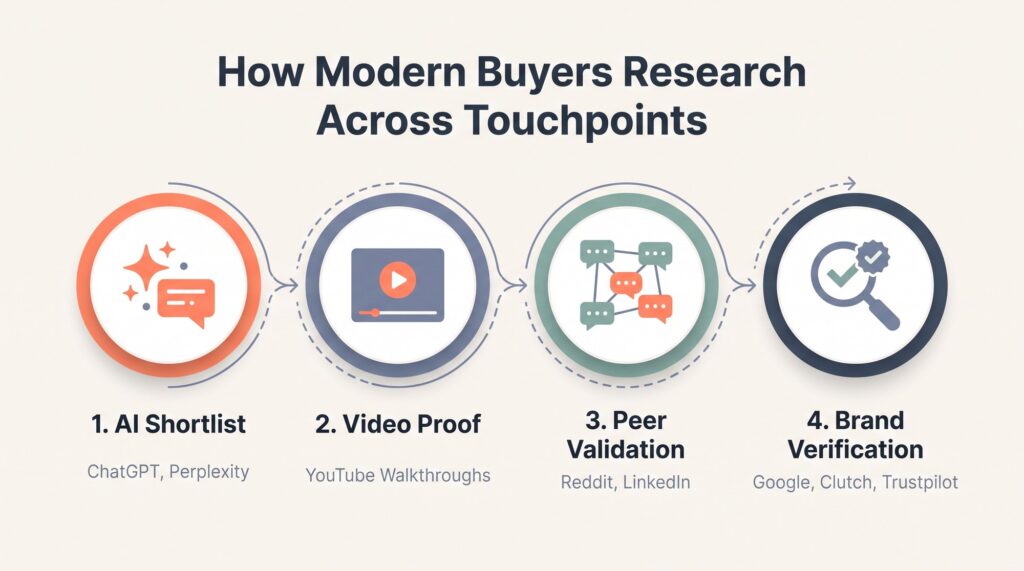
If your brand ranks well on Google but has no video proof or independent reviews, buyers hesitate and choose a competitor that appears active across their entire research path. Businesses that want to connect these touchpoints into one coordinated system often use a dedicated Search Everywhere Optimization service to align their organic footprint.
How Discovery Signals Differ Across Modern Search Surfaces
Every platform with a search bar uses its own retrieval system to decide which content deserves attention. Copy-pasting the exact same post across every network fails because each platform measures value differently.
Web Search Engines and Technical Foundations
Traditional search engines like Google and Bing rely on automated crawlers to index web pages and evaluate their relevance. They examine technical foundations such as page speed, mobile usability, internal link structure, and clean schema markup to understand what your business offers.
Beyond technical health, Google uses multiple automated quality systems to assess whether content demonstrates real-world experience and trustworthiness. As outlined in the Google Search Central documentation, these systems reward original, people-first content while demoting thin pages created solely to manipulate rankings.
Maintaining visibility on Bing and Brave Search has also become much more important. Several leading AI assistants rely on Bing and Brave search indexes to fetch live web information when answering user prompts.
Generative AI Assistants and Source Citations
Conversational AI platforms do not simply match short keywords to web pages. Instead, they break complex user prompts into smaller sub-questions, retrieve information from trusted sources, and synthesize a direct answer.
To earn citations in these responses, your content must provide clear definitions, verifiable statistics, and structured formatting that language models can parse without ambiguity. Just as importantly, AI systems look beyond your own domain to verify your reputation.
An October 2026 analysis of 232.8 million US searches by Ahrefs revealed that AI Overviews now appear on nearly 83% of branded keyword searches. When prospects search your company name, Google and AI tools summarize your brand using both your website and external mentions across the web.
Video Platforms and Demonstration Signals
Video search engines allow buyers to see products in action and hear directly from subject-matter experts. YouTube operates as a long-form discovery engine where users search for detailed tutorials, product comparisons, and in-depth breakdowns.
YouTube evaluates videos using spoken transcripts, chapter timestamps, title relevance, click-through rates, and total watch time. Short-form video platforms like TikTok, Instagram Reels, and YouTube Shorts operate differently. Their search algorithms pay close attention to early viewer retention, on-screen text, caption keywords, and how often users save or share the video with peers.
Community Forums and Social Validation
Buyers turn to community forums and social networks when they want honest, peer-tested opinions rather than polished corporate copy. Many searchers now append the word Reddit to their Google queries specifically to read real user experiences.
On Reddit, visibility depends on genuine participation and helpfulness within relevant communities rather than promotional link dropping. On professional networks like LinkedIn, decision-makers search for founder insights, documented client outcomes, and practical industry commentary to judge whether a company truly knows its craft.
Local Maps and Verified Review Directories
When a buyer is close to hiring a provider or visiting a location, map listings and review directories carry heavy weight. For local businesses, Google Business Profile and Apple Maps surface companies based on geographic proximity, category accuracy, and consistent customer reviews.
For national B2B agencies, SaaS companies, and e-commerce brands, directories like Clutch, G2, and Trustpilot serve the same validation role. Both human buyers and AI assistants scan these third-party profiles to confirm that your business delivers on its promises.
Directly Managed Assets Versus Influenced Digital Spaces
A practical way to organize Search Everywhere Optimization is to separate the digital world into two categories. Every search touchpoint falls into either assets you manage directly or external spaces you can only influence.
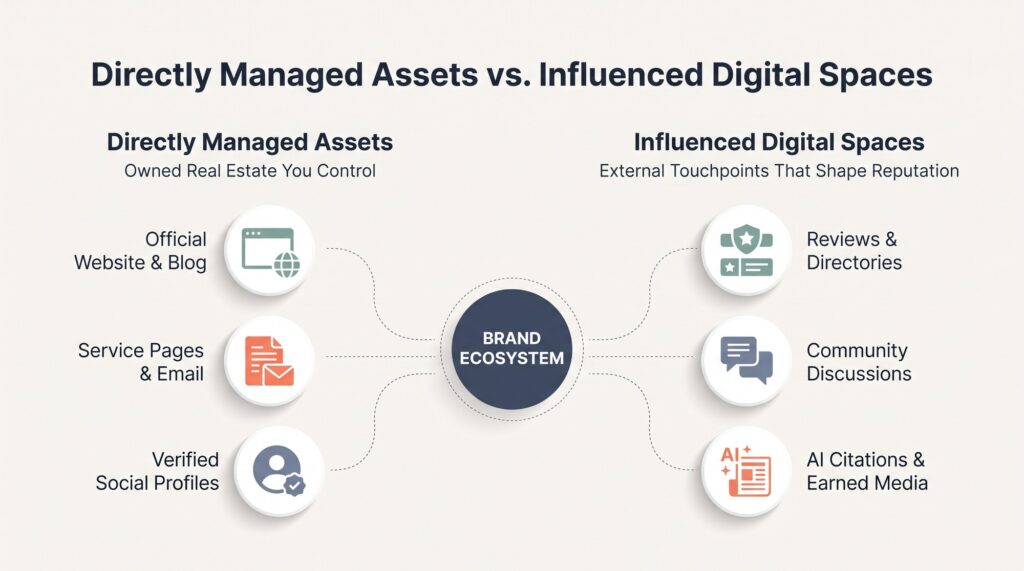
Owned Real Estate That Your Brand Controls
Directly managed assets include your official website, service pages, blog articles, email newsletters, and verified social media profiles. On these properties, you control the exact messaging, visual presentation, technical structure, and conversion pathways.
Your website remains the anchor of this owned ecosystem. Even if a customer discovers your brand through a YouTube video or an AI summary, they almost always visit your website to verify your offer before contacting you. Combining clear search architecture with strong conversion rate optimization ensures that visitors who land on your site can easily take the next step.
External Touchpoints That Shape Market Reputation
Influenced spaces are the platforms where customers, journalists, creators, and community members shape the conversation about your brand. This includes independent product reviews, Reddit discussions, third-party comparison articles, and AI-generated answers.
You cannot directly edit what people write in these spaces, yet they play a massive role in modern search visibility. A May 2026 study of over one million AI links by Muck Rack found that 84% of citations in generative AI responses come from earned media and third-party sources rather than brand-owned websites.
Building strong E-E-A-T in SEO requires earning credible mentions across these external spaces. You influence them by delivering great customer experiences, encouraging honest reviews, sharing original data that journalists cite, and participating constructively in industry discussions.
How to Build a Practical Search Everywhere Strategy
Expanding beyond Google does not mean your team needs to post daily content on ten different networks. The most effective brands follow a focused, step-by-step process to show up where it actually matters for their revenue.
Audit Your Existing Footprint Across Search Channels
Start by checking how your brand currently appears across major discovery surfaces. Search your company name and core service terms on Google, Bing, YouTube, Reddit, and leading AI assistants like ChatGPT and Perplexity.
Document where your business shows up accurately, where your profiles look outdated, and where competitors dominate the conversation. This baseline audit reveals the exact gaps that are costing you buyer trust.
Identify Where Your Target Audience Actually Researches
Before opening any keyword tool, talk to your best customers. Ask five to ten recent buyers how they first heard about your company and which platforms they checked before deciding to work with you.
Combine those answers with your website referral analytics to pick two or three priority platforms alongside Google. A local home service company might focus on Google Search, Google Maps, and Facebook. A B2B consultancy might focus on Google Search, LinkedIn, YouTube, and industry directories.
Map Natural Buyer Questions Instead of Short Keywords
Traditional keyword research often focuses on short two-word phrases. Across social platforms, video channels, and AI tools, people search using full conversational questions.
Group these questions by stage of awareness, from early problem research to side-by-side vendor comparisons, so you can address the exact concerns buyers have before purchasing.
Adapt Core Topics Into Platform Native Formats
You do not need to invent separate ideas for every channel. Instead, start with one well-researched pillar topic on your website and adapt it to fit the native format of each priority platform.
A comprehensive written guide on your blog can become a ten-minute walkthrough video for YouTube, a 45-second visual tip for TikTok or Reels, and a concise insight post for LinkedIn. When you focus on building a strong social presence with search-friendly titles and captions, each piece of content remains discoverable for months rather than disappearing in a daily feed.
Build Off Site Credibility and Third Party Mentions
Make external validation a routine part of your monthly marketing operations. Set up a simple process to request reviews from satisfied clients on Google Maps, Trustpilot, or Clutch right after a successful milestone.
Collaborate with respected creators in your niche, contribute expert commentary to industry publications, and publish original case studies. These third-party signals reinforce your brand entity for both human buyers and search algorithms.
How to Measure Multi Platform Visibility and Business Impact
Because buyers move across several apps before converting, single-click attribution models never capture the full picture. Measuring a Search Everywhere strategy requires looking at four connected indicators.
| Measurement Category | What to Track | Primary Tools | What It Tells You |
|---|---|---|---|
| Web Search Visibility | Organic impressions, clicks, non-branded rankings, and branded query growth | Google Search Console and Bing Webmaster Tools | Whether your website foundation is capturing demand and growing brand awareness |
| Platform Native Engagement | Watch time, audience retention, content saves, profile visits, and shares | YouTube Studio, TikTok Insights, and LinkedIn Analytics | Whether your video and social content actually holds buyer attention and answers their questions |
| AI Visibility and Citations | Brand mention frequency, source link citations, and accuracy of brand descriptions | Repeatable prompt testing in ChatGPT, Perplexity, Gemini, and AI visibility trackers | Whether generative AI systems recognize and recommend your business in buyer shortlists |
| Commercial Business Outcomes | Qualified inquiries, consultation bookings, pipeline value, and self-reported attribution | GA4, CRM tracking, and a How did you find us form field | Whether your multi-platform visibility is translating into real revenue |
Website Search Console Data and Keyword Growth
Use Google Search Console to monitor both topic-level impressions and branded search volume. When more people type your exact company name into Google over time, it is a strong indicator that your video, social, and community presence is creating real market preference.
Platform Native Engagement and Audience Retention
Avoid judging social and video search by superficial view counts alone. Look at average watch duration on YouTube and bookmark saves on Instagram or TikTok, which show that buyers find your content useful enough to revisit later.
Monitoring Brand Presence Across AI Assistants
Create a fixed list of 15 to 20 questions that your ideal customers ask when researching solutions in your category. Test those prompts monthly across ChatGPT, Perplexity, Gemini, and Google AI Overviews to see whether your brand is mentioned accurately and which third-party sources the models cite.
Connecting Discovery Touchpoints to Commercial Outcomes
Analytics tools often credit the final Google search before a form submission while missing the YouTube video or Reddit thread that built the buyer’s trust days earlier. Adding a simple required question asking “How did you first hear about us” on your consultation form bridges this attribution gap and reveals which channels drive your highest-value clients.
Frequently Asked Questions About Search Everywhere Optimization
No. Traditional SEO remains the foundation of digital discovery because your website is the primary place where buyers verify your offer and convert. Search Everywhere Optimization builds on top of technical and on-page SEO by extending your visibility to the AI tools, video channels, and social platforms where buyers conduct the rest of their research.
Most businesses should start with Google plus two or three additional platforms where their target buyers actively research. Trying to launch on ten channels at once leads to thin content and team burnout. Once you establish a consistent workflow on your core platforms, you can gradually expand to new surfaces.
AI models are designed to synthesize reliable answers by cross-referencing information across the web. In addition to reading a company’s official website, AI assistants pull context from independent news articles, review directories, video transcripts, and community forums to verify what third parties say about a brand.
Regular social media posting focuses on short-term feed engagement and entertainment for existing followers. Social search optimization focuses on creating content around the specific questions, keywords, and visual demonstrations that new buyers type into platform search bars when looking for solutions.
Yes. A small team does not need to produce daily videos from scratch. By starting with one strong research topic or customer guide each month and adapting that core asset into a few focused videos, social breakdowns, and search-optimized web pages, even a lean team can build steady multi-platform visibility.
Final Thoughts on Modern Search Visibility
Search has evolved from a single search box into a connected network of discovery platforms. The brands that earn lasting organic growth are not the ones publishing the highest volume of generic articles, but the ones showing up with clear, credible answers wherever their customers look for proof.
By strengthening your website foundation, adapting your expertise for priority discovery channels, and building genuine third-party trust, you turn fragmented search behavior into a durable competitive advantage. If you want an experienced team to architect and execute this system for your business, explore our Search Everywhere Optimization service or view our complete range of digital marketing services.