
What Is SEO and How Search Engine Optimization Works in 2026
Author: MD Mizanur Rahman, Founder and Lead Growth Strategist at Invrse Marketing LLC | Last Updated: October 2026
Search Engine Optimization is the practice of improving a website so search engines like Google and Bing can easily crawl, understand, and rank its pages for relevant user searches. Instead of paying for every click through advertisements, SEO earns unpaid organic traffic by matching real buyer questions with fast, trustworthy, and genuinely helpful web pages.
For years, many website owners treated SEO like a simple word game. If you repeated an exact keyword enough times on a page and pointed a few links at it, your page could climb to the top of Google.
That surface-level approach no longer works in 2026. Modern search algorithms evaluate complete topic coverage, firsthand expertise, technical usability, and real visitor satisfaction rather than simple keyword frequency.
This guide breaks down what SEO means in digital marketing and how search engines actually process websites behind the scenes. You will also learn the four core pillars of organic optimization, why most web pages fail to rank, and how to build a sustainable search foundation step by step.
What Is Search Engine Optimization in Digital Marketing
In digital marketing, SEO is the primary engine for inbound customer acquisition. While social media feeds and display ads push messages toward people who are passively scrolling, search optimization connects your business with people at the exact moment they are actively looking for an answer, service, or product.
According to the Google Search Central SEO Starter Guide, search optimization comes down to helping search engines understand your content and helping users decide whether they should visit your site. When your pages solve problems clearly, organic search becomes a compounding asset that brings in qualified visitors month after month.
Core Differences Between Organic Search and Paid Advertising
Search engine results pages contain two distinct types of listings: paid advertisements and organic search results. Understanding how they differ helps businesses allocate their marketing budget wisely.
| Comparison Factor | Organic Search via SEO | Paid Search via PPC Ads |
|---|---|---|
| Placement on Search Results | Appears in the main organic listings, map packs, and answer features based on relevance and authority | Appears at the top or bottom of the page with a Sponsored label based on ad auction bids |
| Cost Structure | Requires upfront investment in technical health, content creation, and authority building, with zero cost per click | Charges a direct fee every time a user clicks your ad, with costs rising in competitive industries |
| Speed of Results | Takes several months to build indexing momentum, domain trust, and stable page rankings | Generates traffic immediately after launching a campaign and approving ad spend |
| Long Term Compounding Value | Continues attracting qualified visitors and building brand equity long after a page is published | Stops sending traffic the exact moment you pause your advertising budget |
| Buyer Trust Signal | Earns higher trust from discerning buyers who skip past sponsored ads to read credible resources | Works well for immediate offers and promotions, though many users recognize and skip paid placements |
Most growing companies eventually use both channels together. Paid ads provide quick testing data for new offers, while a well-executed Search Engine Optimization service builds long-term visibility that lowers your overall customer acquisition cost. For a complete blueprint on scaling multi-channel digital systems, see our roadmap on how to grow a successful online business in 2026.
Why Keyword Matching Alone No Longer Works on Google
In the early days of search, algorithms relied heavily on lexical matching. If someone searched for a specific phrase, Google looked for pages where those exact words appeared in the title tag, headings, and paragraphs.
Today, Google uses advanced natural language processing systems and machine learning models to understand the underlying meaning and entities behind a search query. Even if two people use completely different words, the search engine recognizes when they are asking for the exact same solution.
Because of this shift, repeating keywords across a shallow article cannot trick the algorithm. Google evaluates whether your page covers the subtopics a knowledgeable expert would naturally include, whether your content genuinely satisfies the user’s question, and whether your website demonstrates real credibility in its field.
How Search Engines Work Behind the Scenes
Before a website can rank for any keyword, it has to pass through Google’s technical processing pipeline. Search engines do not scan the live internet in real time when you type a query; instead, they search their own massive database of pre-processed web pages.
In Google’s official documentation on how search works, Google groups this process into three primary stages: crawling, indexing, and serving search results. Because modern websites rely heavily on code execution before content can be indexed, we separate rendering as its own step below so you can see all four technical checkpoints clearly.
| Pipeline Stage | Official Google Phase | What the Search Engine Does | Common Failure That Blocks Visibility |
|---|---|---|---|
| Stage 1 Crawling | Crawling | Automated bots follow links and sitemaps to discover new or updated URLs | Broken internal links, orphan pages, or disallowed robots directives |
| Stage 2 Rendering | Part of Indexing | A headless Chromium browser executes JavaScript and CSS to build the visual page | Critical text or navigation links hidden behind slow or failing client-side scripts |
| Stage 3 Indexing | Indexing | Algorithms analyze text, media, and entities to store worthy pages in the search index | Thin, duplicate, or unoriginal content stuck in Crawled currently not indexed status |
| Stage 4 Ranking | Serving Search Results | Ranking systems evaluate hundreds of signals to order the best results for a query | Mismatched search intent, weak topical coverage, or lack of independent authority |
Crawling and Discovering Web Pages
The first stage is crawling, where automated bots such as Googlebot scan the web to discover new and updated pages. Crawlers move across the internet by following hyperlinks from already known pages to new URLs and by reading XML sitemaps submitted by website owners.
Googlebot manages its crawling workload by balancing two official concepts: crawl capacity, which ensures the bot does not overload your server, and crawl demand, which prioritizes popular or frequently updated pages. While strict crawl budget limits mainly affect massive e-commerce or publisher sites with tens of thousands of URLs, poor technical structure still hurts smaller business websites.
If your site is cluttered with broken internal links, endless redirect chains, or orphan pages with no internal links pointing to them, crawlers struggle to discover and re-crawl your most important commercial content efficiently.
Rendering Code and Visual Page Structure
Once Googlebot fetches a page’s raw HTML, it moves to the rendering stage. During rendering, Google runs a headless Chromium browser to execute JavaScript, load CSS stylesheets, and assemble the visual Document Object Model just like a human visitor’s browser would.
Many website owners overlook this step and assume crawling and indexing are the only stages that matter. According to Google’s JavaScript SEO documentation, Googlebot queues pages separately for rendering because executing heavy scripts consumes significant computing power.
If your critical body text, product descriptions, or internal navigation links rely on slow client-side JavaScript that fails or times out during rendering, Google may never see that content at all.
Indexing Content and Semantic Entities
After a page is crawled and rendered, Google analyzes its text, images, videos, and structured data to decide whether it deserves a place in the Google Search index. During indexing, the system extracts key concepts, known as semantic entities, and maps how your page relates to broader topics.
Crucially, Google does not index every page it crawls. In fact, one of the most common frustrations website owners see inside Google Search Console is the status message saying a page was crawled but currently not indexed.
When Google skips indexing a page, it usually means the algorithm judged the content to be duplicate, thin, or offering zero new information compared to pages already stored in its database.
Ranking Pages Through Algorithmic Evaluation
When a user types a query into the search bar, Google’s ranking systems scan the index in milliseconds to return the most relevant and reliable pages. Rather than relying on a single formula, Google uses a group of automated ranking systems that evaluate hundreds of signals simultaneously.
These systems weigh the user’s location, device type, and exact search intent alongside the quality, freshness, and authority of every candidate page. Pages that satisfy both the technical requirements of the index and the real-world expectations of human readers earn top positions.
Core Signals Search Engines Use to Evaluate and Rank Websites
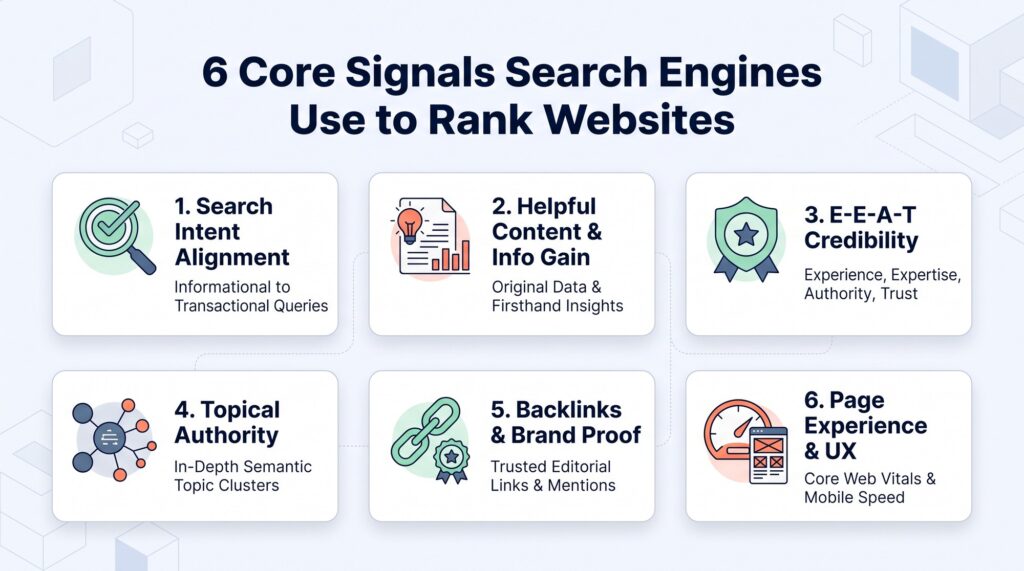
While search engines adjust their weighting over time, Google’s published documentation and large-scale industry analyses—such as the Google Ranking Factors study by Semrush—highlight hundreds of individual signals. To make them practical to manage, we group the most important signals into six core evaluation areas.
Search Intent Alignment and Query Satisfaction
Search intent is the primary goal a person has in mind when typing a query into Google. Every search falls into one of four foundational intent categories:
- Informational intent: involves users looking to learn how something works, understand a concept, or solve a specific problem through educational guides.
- Navigational intent: involves users trying to reach a specific website or brand login page they already know by name.
- Commercial investigation intent: involves buyers comparing options, reading product reviews, or evaluating top service providers before making a choice.
- Transactional intent: involves ready-to-buy users looking to purchase a product, book a service consultation, or sign up for a tool right away.
Matching search intent is the first filter for ranking on Page 1. If users searching a keyword want an actionable pricing calculator or a direct service booking page, Google will not rank a 3,000-word history essay no matter how many keywords it contains.
Helpful Content Systems and Information Gain
Following multiple core algorithm updates, Google integrated its Helpful Content System directly into its core ranking engine. As explained in Google’s guidance on creating helpful, reliable, people-first content, the algorithm actively demotes pages created primarily to attract search engine traffic rather than to help human readers.
During Google Search Core Updates, websites that publish high volumes of repetitive, low-value articles often lose visibility to more comprehensive resources. From an editorial standpoint, the best way to align with Google’s people-first standards is to focus on clear information gain.
Providing information gain means contributing practical value that existing search results have not already repeated. You achieve this by sharing original data, firsthand testing observations, structured comparison tables, or step-by-step explanations drawn from real client work.
Experience Expertise Authoritativeness and Trustworthiness
To evaluate whether a website is credible, Google uses the conceptual framework of Experience, Expertise, Authoritativeness, and Trustworthiness, commonly known as E-E-A-T. While E-E-A-T is not a single mathematical score, Google’s automated systems look for tangible signals on and off your website that mirror human trust.
Strong E-E-A-T in SEO starts with transparent authorship, verifiable company credentials, accurate citations to primary research, and firsthand proof that you have actually done what you are writing about. Trust is the center of this framework, especially for commercial pages where customers invest money or share personal information.
Topical Authority and Semantic Coverage
Search engines no longer evaluate a single web page in complete isolation. Instead, they evaluate how thoroughly your entire domain covers a subject area.
When a website publishes a connected cluster of in-depth guides, technical breakdowns, and case studies around its core expertise, search engines can map the domain’s focus much more clearly. In our experience managing client campaigns—and across broad consensus among SEO practitioners—a website with deep topical coverage earns initial impressions and rankings for related subtopics more reliably than a general site publishing random articles on unrelated subjects.
Backlinks and Independent Brand Authority
Even if your own website presents strong content, search engines look for external confirmation from the rest of the web. A 2023 Ahrefs study of roughly 14 billion web pages found that 96.55% of analyzed pages received zero organic traffic from Google, noting that pages with more referring domains consistently earned more search traffic. In our experience auditing client sites, pages also stay invisible when they target topics with no search demand, miss user intent, or suffer from technical indexing errors.
When a respected publication, university, or industry website links to your page or mentions your brand name in a relevant context, it acts as an independent vote of confidence. One natural editorial link from a real, trusted site in your industry carries far more weight than hundreds of low-quality directory links.
User Engagement Signals and Page Experience
Getting a searcher to click your result on Google is only the first step. As outlined in Google’s official page experience documentation, ranking systems reward pages that deliver a fast, secure, and user-friendly experience once a visitor arrives.
If a page loads slowly on mobile, buries the main answer under intrusive pop-ups, or looks untrustworthy, visitors leave immediately to check a competitor instead. Combining responsive page speed with clean conversion rate optimization keeps human readers engaged and turns organic traffic into qualified business inquiries.
The Four Foundational Pillars of Search Engine Optimization
To manage all of these ranking signals systematically, practitioners divide SEO into four connected pillars. Every successful organic strategy relies on these four areas working together.
| SEO Pillar | Where It Happens | Primary Objective | Key Elements Involved |
|---|---|---|---|
| Technical SEO | Website server, code, and site architecture | Ensure search engines can crawl, render, and index pages fast and without errors | XML sitemaps, robots directives, Core Web Vitals, mobile responsiveness, HTTPS security, and schema markup |
| On Page SEO | Individual web page HTML and structure | Clarify the exact topic, intent, and entity relationships of a specific page | Title tags, URL slugs, H1 to H3 heading hierarchy, internal links, image alt text, and meta descriptions |
| Content SEO | Written copy, visuals, and data tables | Satisfy user search intent completely while demonstrating firsthand expertise | Topic depth, semantic subtopics, micro-readability, original examples, and E-E-A-T trust proof |
| Off Page SEO | External websites, publications, and directories | Build independent domain authority, backlinks, and brand reputation across the web | Editorial backlinks, digital PR, unlinked brand mentions, review profiles, and industry citations |
Technical SEO for Crawlability and Site Health
Technical SEO builds the foundation of your website so search engine crawlers and human visitors can access your pages without friction. Even the best written article on the internet will fail to rank if a rogue noindex tag blocks Googlebot or if the page takes eight seconds to load on a smartphone.
As a commonly recommended site-architecture best practice, organizing a logical hierarchy where every important page is reachable within three clicks from the homepage helps both users and crawlers navigate your site effortlessly. It also involves optimizing Core Web Vitals metrics such as Largest Contentful Paint and Interaction to Next Paint, fixing broken 404 pages, eliminating duplicate URLs with canonical tags, and deploying clean schema markup so search engines understand your company details and page types.
On Page SEO for Relevance and HTML Structure
On-page SEO is the process of structuring individual web pages so both search algorithms and human readers immediately grasp what the page is about. As documented by Search Engine Land, effective on-page optimization aligns HTML code signals with human readability.
Your URL slug should be short, descriptive, and focused on the core topic. Your title tag and H1 heading should state the primary subject clearly, while H2 and H3 subheadings break the topic into logical sections that mirror the follow-up questions searchers naturally ask.
Just as importantly, on-page SEO includes strategic internal linking. When you connect related articles and service pages using descriptive anchor text, you help search engines map your topical hierarchy and pass authority to your most important pages.
Content SEO for Intent Depth and Readability
Content SEO focuses on the substance, clarity, and structure of the information on the page. Modern readers rarely read long walls of text word for word; instead, they scan headings, tables, and short paragraphs to find the exact answer they need.
To make content helpful for humans, write in short, direct paragraphs of two to three sentences. Answer the main question immediately under each heading before expanding with supporting context, verified statistics, and real-world examples.
Instead of forcing awkward keyword variations into every paragraph, focus on covering all the natural subtopics and terminology a reader needs to fully understand the subject.
Off Page SEO Backlinks and Digital Reputation
Off-page SEO encompasses every action taken outside of your own website to build your domain’s reputation and authority in search engines. Because anyone can publish self-promotional claims on their own site, Google relies heavily on off-page signals to verify which brands are genuinely respected in their market.
Earning high-quality backlinks through original data studies, expert commentary, digital PR, and helpful tools remains the cornerstone of off-page SEO. At the same time, companies must strictly follow Google’s web search spam policies by avoiding automated link networks or manipulative link schemes that can trigger ranking penalties.
Beyond direct hyperlinks, consistent brand mentions in industry articles, podcasts, and verified review platforms reinforce your company as a trusted entity.
How SEO Works Step by Step in Practice
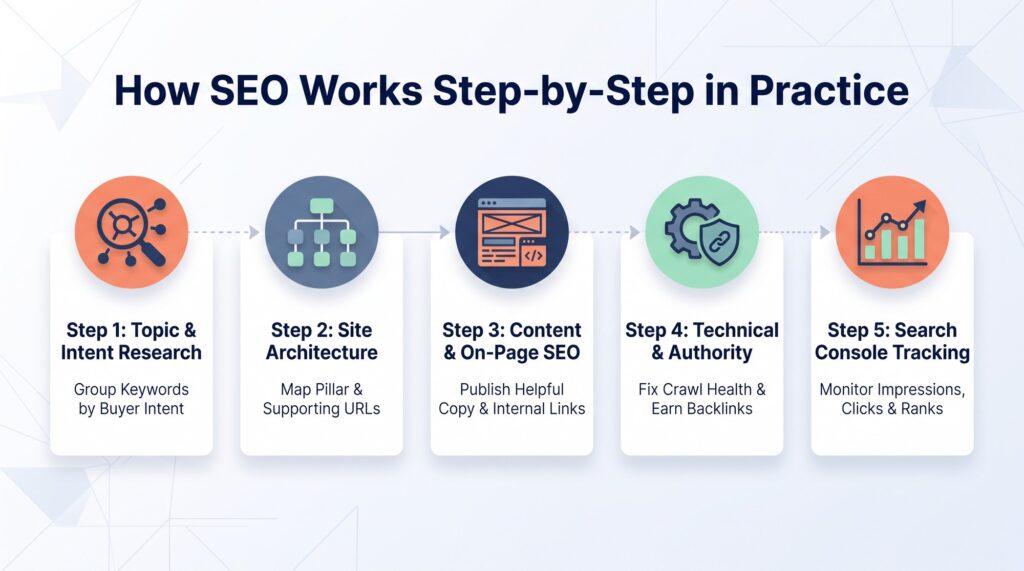
Understanding how search engines work is only valuable when you translate it into a repeatable workflow. Whether you manage your own website or partner with an agency, effective SEO follows five practical stages.
Step 1: Topic and Search Intent Research
Every campaign begins by researching how your target customers actually search for solutions. Instead of chasing a single high-volume keyword with massive competition, smart research groups keywords into topical clusters based on user intent.
You separate commercial queries—where buyers are looking to hire a provider or buy a product—from informational queries where users want to learn how a process works. By inspecting the current top ten results on Google for each target phrase, you identify the exact page format, subtopics, and depth required to compete.
Step 2: Site Architecture and Content Mapping
Once you have your keyword clusters, you map each topic to a specific URL on your website. A cardinal rule of SEO is assigning one distinct primary intent per page so your own URLs never compete against each other for the same search query, a problem known as keyword cannibalization.
During this planning stage, you organize your website into clear pillar pages and supporting articles. Your commercial service pages target bottom-of-funnel buyers, while your educational guides answer foundational questions and link contextually back to your core services.
Step 3: Content Production and On Page Optimization
With the blueprint locked in, you write or upgrade each page to be the clearest, most thorough resource available for that topic. You open each section with direct answers, weave in relevant semantic concepts naturally, and back up claims with links to primary data sources.
Before publishing, you refine the title tag, meta description, heading hierarchy, image alt attributes, and internal links to ensure both crawlers and human visitors have a frictionless reading experience.
Step 4: Technical Fixes and Authority Building
As content goes live, you audit the website’s technical health to make sure every new page is crawled, rendered, and indexed cleanly. You resolve mobile usability bottlenecks, compress oversized media files, and verify that internal links point directly to canonical URLs without redirect hops.
Alongside technical maintenance, you promote your best informational assets and build relationships within your industry to earn relevant editorial backlinks and credible brand citations.
Step 5: Tracking Performance in Google Search Console
SEO is never a set-and-forget task. Once your pages are indexed, you monitor their real-world performance inside Google Search Console and web analytics.
By tracking which queries generate impressions, where your average ranking positions sit, and which pages earn clicks, you can spot pages sitting on Page 2 of Google. Updating those pages with sharper answers, better examples, and stronger internal links often pushes them onto Page 1 without needing to write a brand-new article from scratch.
How Local SEO Works for Service and Regional Businesses
When a search query carries geographic intent—such as someone searching for an emergency plumber, a dental clinic, or an accounting firm in their city—Google changes the layout of the search results entirely. Alongside standard web pages, Google displays a Local Map Pack featuring three nearby businesses with their star ratings, hours, and directions.
According to Google’s official guidance on improving local ranking, Google determines local search visibility primarily by evaluating three core factors:
- Relevance: measures how closely your Google Business Profile categories, website service pages, and business description match what the user is searching for.
- Distance: calculates how physically close your verified business location or service area is to the searcher’s current location.
- Prominence: evaluates how well-known and trusted your business is locally, based on the volume, recency, and quality of your Google reviews, local backlinks, and consistent Name, Address, and Phone details across trusted directories.
For contractors, medical practices, and regional service providers, mastering local SEO for service businesses is often the fastest way to generate high-intent phone calls and booked appointments.
How Traditional SEO Is Evolving Alongside AI and Multi Platform Search
While traditional search engine optimization for Google and Bing remains the foundation of organic discovery, how search results appear and how buyers research companies has expanded significantly in 2026.
First, a June 2026 SparkToro study analyzing U.S. Google searches between January and April 2026 via Similarweb data found that 68% of searches ended without a click to an external website, up from roughly 60% in 2024, with SparkToro noting that AI Overviews are a likely contributor. Second, many buyers cross-check recommendations across conversational AI tools, YouTube videos, and Reddit threads before choosing a provider.
Because of these shifts, three specialized disciplines now work alongside traditional website SEO:
- Answer Engine Optimization (AEO): focuses on formatting definitions, comparisons, and step-by-step lists so search engines and voice assistants can extract direct answers cleanly.
- Generative Engine Optimization (GEO): focuses on strengthening brand entity clarity, original data, and third-party citations so AI systems like ChatGPT, Perplexity, and Google AI Overviews reference your business accurately.
- Search Everywhere Optimization: connects traditional website SEO with video search, social discovery, and review directories so buyers find consistent proof of your expertise across every platform they check.
None of these modern approaches replace traditional SEO. As Google confirms in its developer guide on optimizing for generative AI features, its AI features rely on the exact same core crawling, indexing, helpful content, and anti-spam systems that power standard Google Search. Your website remains the central source of truth that feeds both organic search rankings and multi-platform AI visibility.
How Long SEO Takes to Show Real Results
One of the most important realities for any business owner to understand is that SEO is a long-term compounding investment, not an instant traffic switch. Unlike paid ads that deliver clicks the afternoon you turn them on, organic search requires earning algorithmic trust over time.
Large-scale industry data highlights why patience and structure matter. According to an Ahrefs study on how long it takes to rank in Google, 72.9% of pages ranking in the top 10 results are more than three years old, and only 1.74% of newly published pages reach the top 10 within their first year.
The exact timeline for your website depends on four practical variables:
- Current domain baseline: determines how quickly search engines crawl and trust your new pages, with established domains gaining traction faster than brand-new websites.
- Keyword competition: dictates how much content depth and backlink authority you need to overtake the pages currently holding Page 1 positions.
- Technical health and implementation speed: control how fast you resolve indexing bottlenecks and publish optimized service and supporting pages.
- Consistency of topical and off-page execution: separates websites that compound visibility month after month from those that stall after publishing a few isolated posts.
Because cracking the top 10 for competitive terms takes sustained effort, you should treat the phases below as realistic visibility milestones rather than ranking guarantees:
- Months 1 to 3: focus on resolving technical bottlenecks, cleaning up indexing errors, and earning initial Google Search Console impressions for low-competition, long-tail queries.
- Months 4 to 6: bring compounding visibility across connected topic clusters, where search impressions climb sharply and steady organic clicks and initial buyer inquiries begin to materialize.
- Months 7 to 12 and beyond: position the domain to compete for established, higher-competition commercial keywords as topical authority and backlinks mature.
What We See in Practice Building Search Visibility from Zero on a Lean Budget
To see what early SEO traction actually looks like in the real world, consider a business we discovered while auditing websites in a service niche. The owner had invested heavily in a sleek, custom-designed website and ran a legitimate operation, yet our diagnostic check showed their organic search visibility was flat at zero.
Like many founders, the owner simply did not realize that a well-designed website remains invisible on Google unless its pages are structured for search intent and technical indexing. In fact, the business did not even have a Google Search Console property set up to see whether Googlebot was discovering its pages.
We reached out to the owner, shared our audit findings, and explained what the site needed to start showing up in search. Because the founder was completely new to SEO and wanted to test the waters before committing a large budget, they agreed to a lean five-month engagement with zero extra budget for paid guest posts or digital PR outreach.
During Month 1, we set up Google Search Console, fixed technical indexing bottlenecks, and completed foundational on-page optimization across their core pages. Over Months 2 through 5, without a budget for high-tier editorial guest posts, we published helpful supporting content and built foundational off-page presence and social proof across community and publishing platforms such as Reddit and Medium.
Had the campaign included a dedicated budget for authoritative editorial backlinks, the site could have pushed into top positions and higher click-through rates much faster. Even on a lean test budget, the combined on-page restructuring and foundational authority work coincided with a clear shift from complete invisibility to measurable daily search activity.
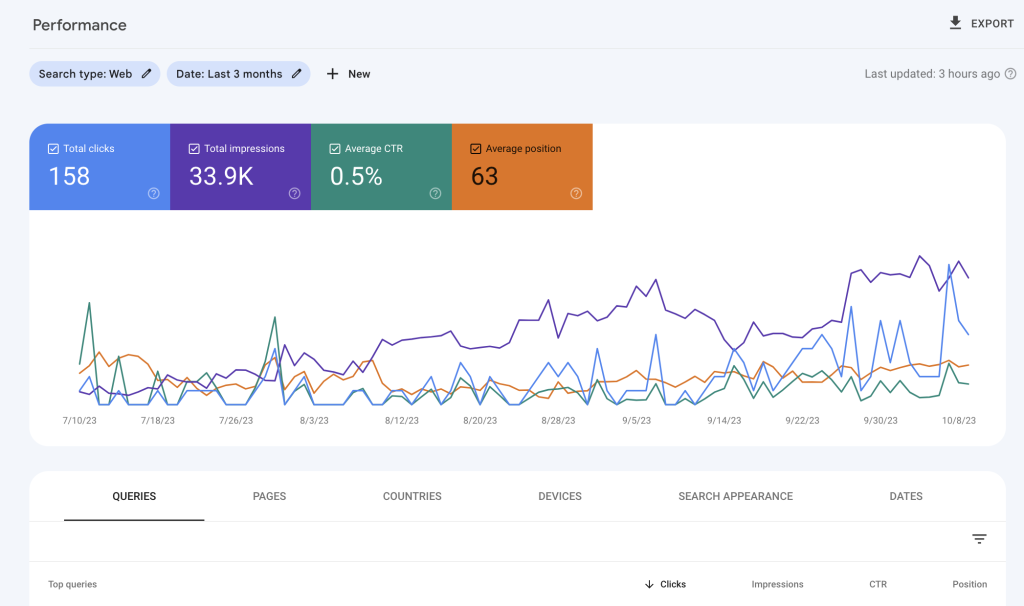
Across the final 90-day tracking window of that five-month engagement (July 10 to October 8 in Google Search Console), the domain grew from zero visibility to 33,900 organic impressions and 158 search clicks (an average CTR of 0.5% and average position of 63 as hundreds of new service and informational queries entered the index), with a sharp upward surge in both impressions and clicks during the final month. While we cannot isolate any single change as the sole trigger, the combined fixes gave the business owner the proof they needed to see organic search working firsthand.
Common Mistakes That Stop Websites from Ranking
When businesses invest time or money into SEO without seeing a return, the failure almost always traces back to a handful of avoidable mistakes.
Publishing Unedited Generic Content at Scale
Many websites try to take a shortcut by publishing dozens of unedited, surface-level articles generated purely to hit a high word count. Because these articles merely repeat what is already on the web without adding firsthand experience or verified data, Google’s core updates quickly filter them out or refuse to index them altogether.
Targeting Broad High Competition Keywords Too Early
A new or mid-sized website cannot immediately outrank multibillion-dollar software companies for broad, one-word industry terms. Smart SEO builds momentum from the ground up by targeting specific, high-intent service queries and low-competition informational questions first, building the topical authority needed to compete for bigger terms later.
Ignoring Technical Indexing and Internal Links
Publishing a great guide does nothing for your business if it sits as an orphan page with zero internal links pointing to it from the rest of your website. Every page on your domain should belong to a clear topical cluster, linking naturally to related educational guides and relevant commercial service pages so both users and search crawlers can navigate your expertise effortlessly.
Chasing Vanity Traffic Instead of Business Relevance
Ranking number one for a high-volume trivia question that has zero connection to what your company sells will never pay your bills. Effective SEO prioritizes search intent and buyer relevance over raw traffic numbers, ensuring that the visitors landing on your website are the actual people who need your products or services.
Frequently Asked Questions About SEO
SEO stands for Search Engine Optimization. In digital marketing, it is the process of improving your website's technical structure, on-page content, and off-site authority so your pages rank higher in unpaid search results on platforms like Google and Bing, attracting relevant visitors who are actively searching for what your business offers.
SEO works by aligning your website with the four stages we break down in this guide: crawling, rendering, indexing, and ranking. You research the exact questions your customers type into search bars, publish clear and helpful pages that answer those questions better than competitors, make your site fast and easy for bots to read, and earn links from other trusted websites to prove your credibility.
On-page SEO covers all the optimizations you control directly on your own website, including your page titles, headings, body content, internal links, URL structure, and image alt text. Off-page SEO covers the trust signals built outside of your website, such as earning backlinks from respected publications, getting brand mentions, and gathering verified customer reviews across the web.
A backlink is a hyperlink on another website that points visitors and search engine crawlers to a page on your website. Search engines treat relevant, natural backlinks from reputable websites as independent votes of confidence, making backlink quality one of the strongest signals for ranking in competitive search results.
If your pages are indexed in Google Search Console but stuck on Page 4 or Page 5, it usually means your content does not match the dominant search intent, lacks sufficient depth compared to Page 1 competitors, or has weak internal and external link authority. Reviewing the top ten ranking pages for your target keyword and upgrading your page with clearer structure, original insights, and internal links from related pages on your site helps break through ranking plateaus.
Timelines vary depending on your industry competition, site health, and execution pace, so no honest practitioner can promise exact dates. As a realistic planning benchmark, months one to three typically bring cleaner indexing and early impressions for low-competition, long-tail queries; months four to six generate compounding impressions and initial organic clicks across your topic clusters; and months seven to twelve are typically required to compete for established, high-competition commercial keywords.
SEO focuses strictly on earning unpaid organic visibility in search engines. PPC, which stands for Pay-Per-Click, refers strictly to paid search advertising where you pay a fee each time a user clicks your ad. SEM, or Search Engine Marketing, is the broader umbrella term that combines both organic SEO and paid PPC advertising to capture search demand.
You can handle basic SEO yourself by learning how to research customer questions, write helpful articles, optimize your page titles, and set up Google Search Console. However, when your business faces tough competition, complex technical indexing issues, or lacks the internal time to execute content and link outreach consistently, partnering with a dedicated team becomes much more cost-effective.
Building a Sustainable Search Foundation for Your Business
Search Engine Optimization has evolved far beyond old-school keyword tricks, yet its core purpose remains unchanged. Search engines exist to connect people who have questions or problems with the most reliable, helpful answers on the internet.
When you build a technically clean website, publish people-first content backed by real expertise, and connect your pages into a coherent topical structure, every piece of work compounds over time. If you want an experienced partner to diagnose your website’s current bottlenecks and execute a complete organic roadmap, explore our Professional Search Engine Optimization service or see how we unify multi-channel visibility through our Search Everywhere Optimization service.


Pingback: How to grow a successful online business in 2026? - Invrse Marketing LLC