
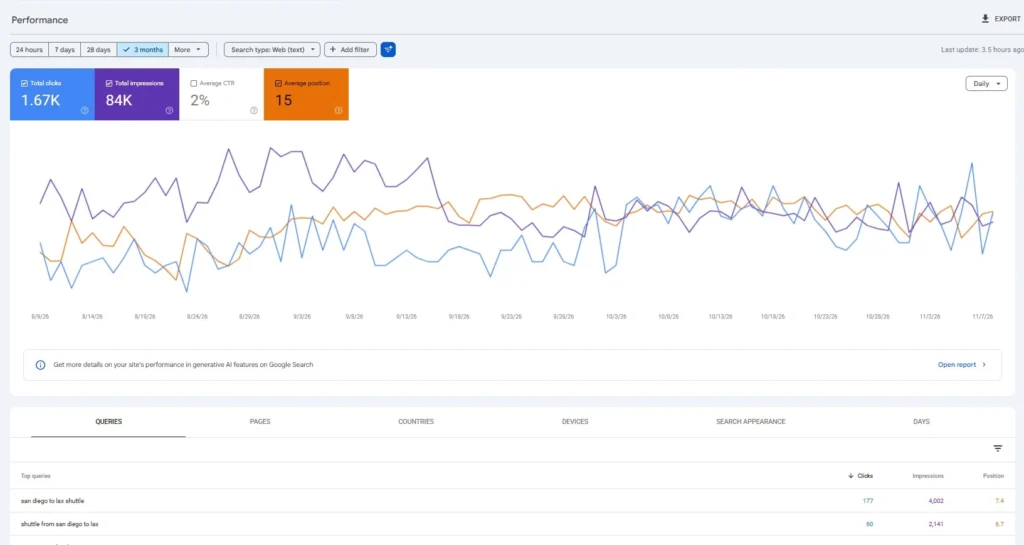
What Do the Last 3 Months of Search Console Data Show?
Over the 90-day window from August 8 to November 7, 2026, the website generated 1.65K organic clicks and 84.1K impressions with a 2.0% average click-through rate and an average ranking position of 15.1.
The real story sits in the month-over-month acceleration. In August 2026, the site averaged roughly 13 clicks per day at a 1.36% CTR and an average position of 20.4. By October and early November 2026, daily clicks climbed to 23.7 per day (peaking at 38 clicks in a single day on November 6) at a 2.92% CTR and an average position of 13.1—all while total daily impressions became 14% leaner.
Earning significantly more clicks from fewer impressions is the exact outcome a booking business needs. Before our work, the site accumulated empty Page 3 and Page 4 impressions on broad, unaligned searches that never converted. Today, as AI answers satisfy casual top-of-funnel browsers directly on the results screen (zero-click searches), the clicks that reach the website come from high-intent travelers checking rates and booking options.
What Were the Results at a Glance?
All figures below come directly from 16 months of verified Google Search Console performance data (July 8, 2025 to November 7, 2026) and an Ahrefs site and AI citation snapshot taken on November 9, 2026.
| Metric | Before the Crash (Sep 1, 2025 to Feb 28, 2026) | The Crash Window (Mar 4 to Apr 20, 2026) | Post-Recovery (Oct 11 to Nov 7, 2026) |
|---|---|---|---|
| Clicks per day | 18.4 per day | 0.3 per day | 23.7 per day (Peak: 38 on Nov 6) |
| Impressions per day | 1,287 per day | 16 per day | 812 per day (Targeted Page 1 routes) |
| Click-through rate (CTR) | 1.43% | 1.88% (14 clicks across 48 days) | 2.92% (More than doubled) |
| Average ranking position | Position 21.0 (Page 3) | Too few impressions to measure | Position 13.1 (Core routes at Pos 6 to 7) |
| Zero-click days | Zero days (Sep 2025 to Feb 2026) | 38 days out of 48 (Mar 4 to Apr 20, 2026) | Zero days (100% active daily traffic) |
| Google Generative AI impressions | Not reported by Google (report data begins May 18, 2026) | Not reported | 148 to 156 per day (15.5K since May 18) |
| AI answers citing the site (Ahrefs) | None tracked | None tracked | 47 active citations (with a 0.2 DR) |
Impressions are lower than before the crash on purpose: we eliminated thousands of useless impressions from broken and duplicate pages so the domain could concentrate its ranking power on high-converting commercial searches.
What Happened to the Client’s Google Traffic in March 2026?
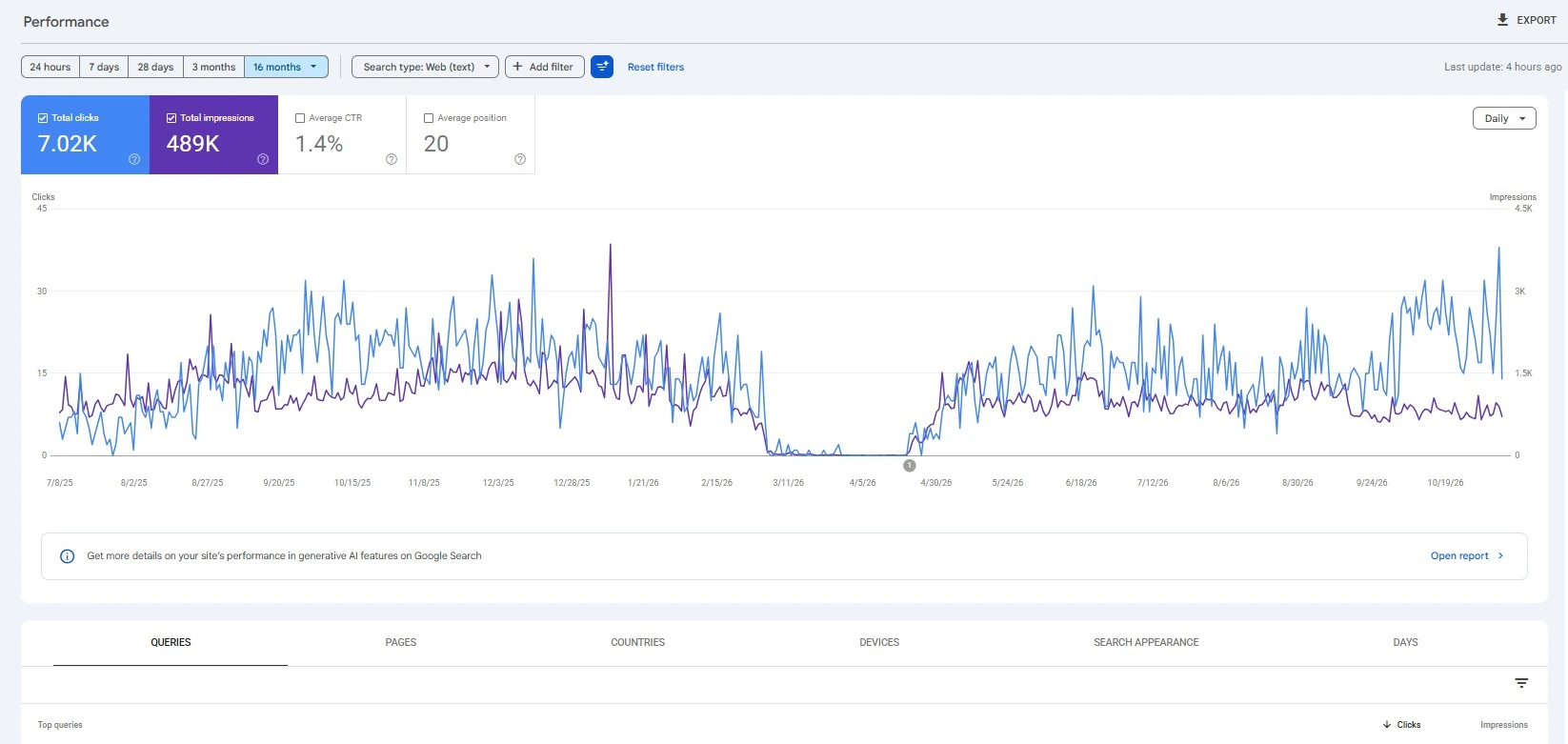
On March 4, 2026, the website’s daily impressions collapsed from 341 to 58 in a single day, trapping the business in a 48-day flatline where it recorded zero clicks on 38 days and zero impressions across the entire domain on April 4 and April 8.
During the eight months prior to the crash, the website had collected around 1,300 impressions and 18 clicks a day, sitting mostly on Page 2 and Page 3 of Google. When the sudden March drop hit, the business lost its primary source of new online bookings overnight.
Google rolled out its March 2026 spam update (March 24 to 25) and March 2026 core update (March 27 to April 8) later that month. Because the drop started three weeks before those rollouts, the algorithm updates did not initiate the crash—instead, they locked the domain at the bottom of the index because the website suffered from severe technical, speed, and structural flaws.
What Did Our Technical and On-Page Audit Find?
When the client partnered with us in mid-April 2026, they made one constraint clear from day one: they had zero budget for paid link building or digital PR campaigns. We discussed off-page authority options, but the client could not allocate budget toward backlinks. If we were going to save the site, we had to do it entirely through technical engineering, on-page restructuring, and schema architecture.
Our forensic audit uncovered eight critical weaknesses holding the domain back:
- Duplicate page trees splitting authority. Live copies of the homepage and core service pages sat indexed beside the real ones (
home-2,rates2,services-2,contact-us-2,about-us-2), while nearly every local city page had a numbered-2or-3twin competing against itself. - Indexable image attachment pages. WordPress was generating a separate, indexable webpage for every uploaded image file—including raw files named after AI image prompts—flooding Google’s index with thin, zero-value URLs.
- A 45% crawl error rate. In our Ahrefs crawl audit, roughly 45% of crawled URLs returned
4XXclient errors, wasting Googlebot’s crawl budget on dead ends. - Poor technical page speed and Core Web Vitals (LCP). Heavy, unoptimized banner images, render-blocking scripts, and bloated page templates caused slow Largest Contentful Paint (LCP) and poor mobile loading performance, hurting both user experience and crawl efficiency.
- Outdated, disconnected Schema markup. The website had basic default plugin schema, but nothing that declared how its service pages and articles related to each other, which cities the business served, or why its pricing and credentials could be trusted by AI engines.
- Weak E-E-A-T and entity trust signals. The site lacked clear organizational identity signals, verified driver licensing disclosures, and consistent regional entity alignment—and even contained leftover template copy referencing the wrong state before we cleaned it up.
- Unstructured walls of text with no extractable answers. Pages were written as generic marketing paragraphs with no quick answer blocks, no comparison tables, and no structured FAQs for Answer Engines to lift.
- No tracked AI search presence and a 0.2 Domain Rating. Before our work, the site had no tracked citations across Google AI Overviews, ChatGPT, Gemini, or Perplexity, and a Domain Rating (DR) of just 0.2.
How Did We Recover the Site Without a Backlink Budget?
We recovered the website and built its AI search visibility from scratch without buying a single backlink—relying 100% on our six-step Search Everywhere Optimization engineering process.
- Deleted duplicate trees and consolidated canonical URLs. We eliminated every
-2and-3duplicate city and service copy, routed equity into a single canonical URL per topic via 301 redirects, disabled media attachment page indexing, and repaired the broken4XXinternal links. This core Search Engine Optimization cleanup delivered our fastest initial win—restoring indexing within 48 hours. - Engineered a dedicated single-page architecture for every service and city. Instead of forcing all routes onto one generic page, we structured one focused, authoritative page for each specific airport corridor and each local city. Covering 41 Southern California cities and 6 major airport and cruise hubs with dedicated pages gave both Google and AI engines an unmistakable landing page to rank and cite for every local query.
- Fixed Core Web Vitals and Largest Contentful Paint (LCP) speed. We compressed oversized hero banners into next-gen WebP formats, stripped out render-blocking bloat, and streamlined mobile rendering so pages loaded faster for both mobile travelers and AI crawlers.
- Deployed relational Schema markup and strong E-E-A-T signals. We replaced the outdated default markup with custom JSON-LD Schema that explicitly declared how pages and articles relate to one another (
isPartOf,about,mentions, andBreadcrumbList), connected the company’s E-E-A-T trust signals (Organization,LocalBusiness,Service,FAQPage, author, publisher, andsameAsentity links), and highlighted real-world proof such as licensed, background-checked drivers and 24/7 flight tracking. - Added 40-to-60-word Quick Answer Blocks, comparison tables, and structured FAQs. We rewrote the top of every core page to open with a crisp, self-contained answer block stating operating hours, flat-rate terms, vehicle options, and route details. We also built a plain HTML pricing matrix (41 cities across 6 destinations = 246 flat-rate cells), service comparison tables, and question-based FAQ sections. In our 400-query Google AI Overview study, 32.1% of citations came from 40-to-60-word direct answers and 27.2% came from clean HTML tables.
- Rewrote page copy for real traveler intent. We replaced repetitive keyword stuffing with clear, helpful answers that address the exact questions travelers ask before booking an airport transfer—ensuring every visitor who clicks through has what they need to book immediately.
| Recovery Milestone Date | What Happened |
|---|---|
| March 4, 2026 | Daily impressions collapse from 341 to 58 in a single day, beginning a 48-day flatline |
| Mid-April 2026 | Client partners with Invrse Marketing (with zero budget for backlinks) |
| April 20 to 22, 2026 | Technical index, speed, and canonical cleanup deployed; impressions jump from 16 to 266 in 48 hours |
| May 2, 2026 | Daily organic impressions pass 1,500 per day as full indexation returns |
| May 18, 2026 | Google’s Generative AI Features report begins recording data; the website appears in it from the first day |
| May to September 2026 | Relational schema, HTML pricing tables, and answer blocks roll out; average position climbs from 21.0 to 13.2 |
| October 2026 | Organic CTR doubles to 2.85% (2.92% over the last 28 days) and daily clicks average 23.3 for the month |
| November 6, 2026 | Website hits a record 38 organic clicks in a single day (highest in the 16-month data) |
How Does Ahrefs Show the Organic Recovery?
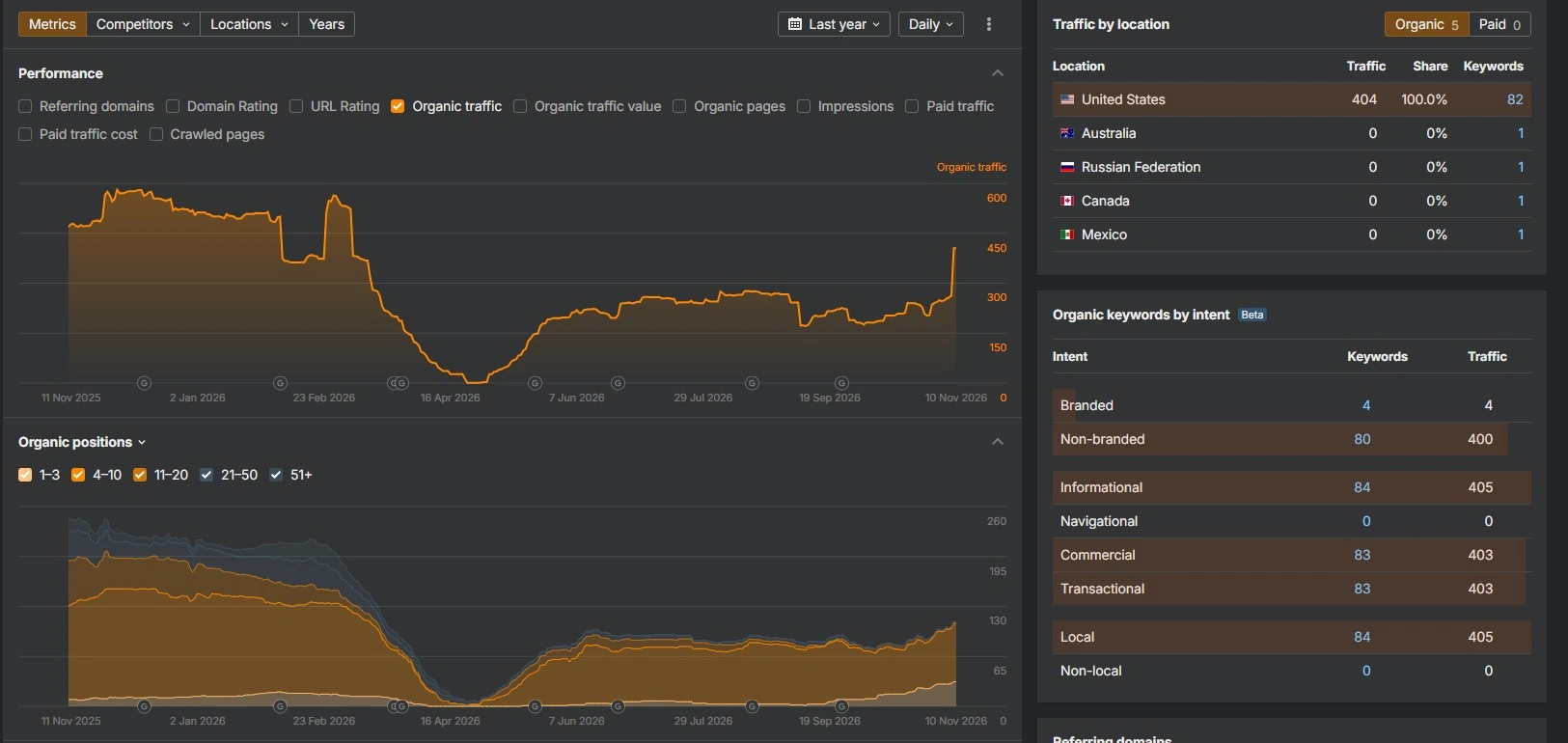
Ahrefs’ independent tracking confirms an organic recovery starting right after our mid-April technical overhaul, with nearly 99% of the tracked keyword portfolio matching commercial and transactional buyer intent.
In the Ahrefs performance graph above, estimated organic traffic and top-10 keyword positions bottomed out in mid-April 2026, rebounded sharply through May and June as our consolidated city and route pages re-indexed, and reached their strongest point since the collapse in November 2026.
Even more important for lead quality is the Organic Keywords by Intent breakdown on the right side of the screenshot:
- 80 out of 84 tracked keywords (95.2%) are Non-Branded, bringing in new customers who did not previously know the company’s name.
- 83 out of 84 keywords (98.8%) carry Commercial and Transactional intent, meaning searchers are actively comparing rates or ready to book a ride.
- 84 out of 84 keywords (100%) carry Local intent within the United States.
How Many AI Answers Cite the Website Today?
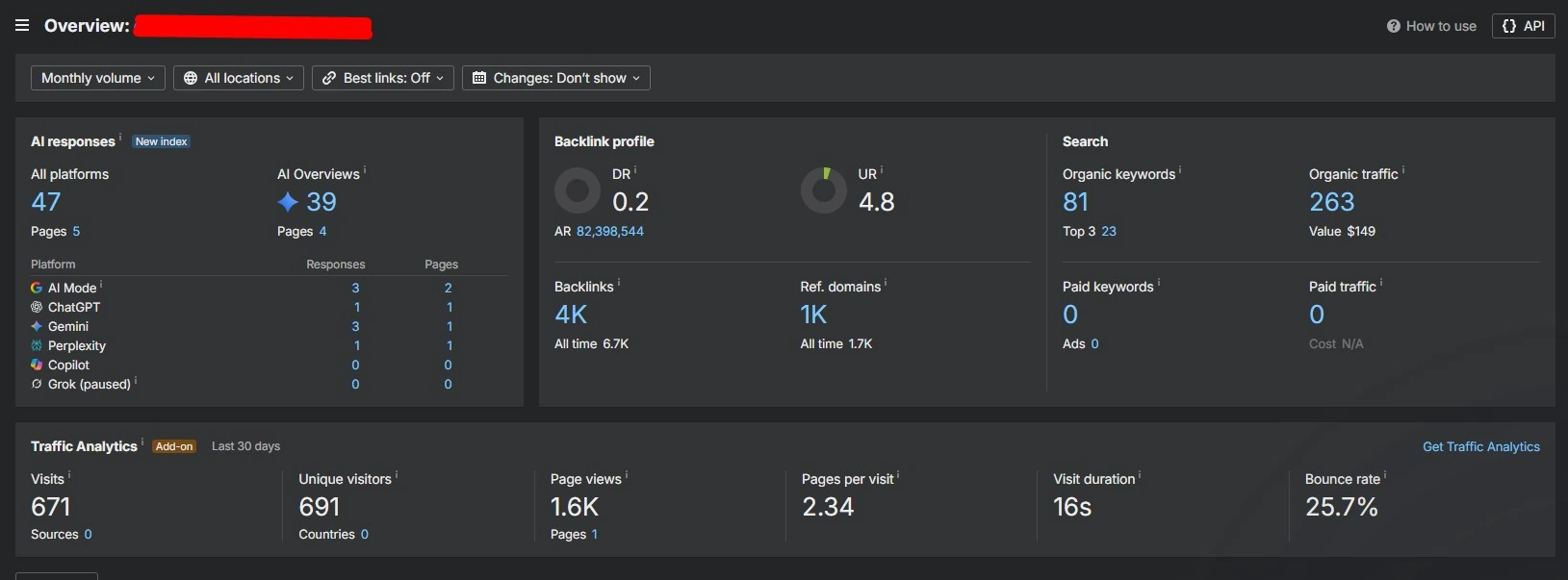
Despite having zero paid backlink budget and a Domain Rating (DR) of just 0.2, the website now holds 47 active citations across 5 core pages inside Google AI Overviews, Google AI Mode, Gemini, ChatGPT, and Perplexity.
Ahrefs’ AI Responses monitor breaks down the 47 live citations across major answer and Generative Engine Optimization platforms:
- 39 citations in Google AI Overviews (across 4 pages)
- 3 citations in Google AI Mode (across 2 pages)
- 3 citations in Google Gemini (1 page)
- 1 citation in ChatGPT (1 page)
- 1 citation in Perplexity (1 page)
Look at the engagement metrics in the bottom panel of the screenshot: out of 81 ranking keywords, 23 keywords now rank in the Top 3 positions on Google, and visitors arriving on the site record an exceptionally low 25.7% bounce rate and view 2.34 pages per visit. This is the exact outcome our AI Search Optimization engineering is built to deliver: proving that clean technical structure, relational schema, quick answer blocks, and HTML pricing tables can put a DR 0.2 domain on Page 1, ahead of the competitors ranking below it, without a backlink campaign.
How Did the Site Perform in Google’s Generative AI Features?
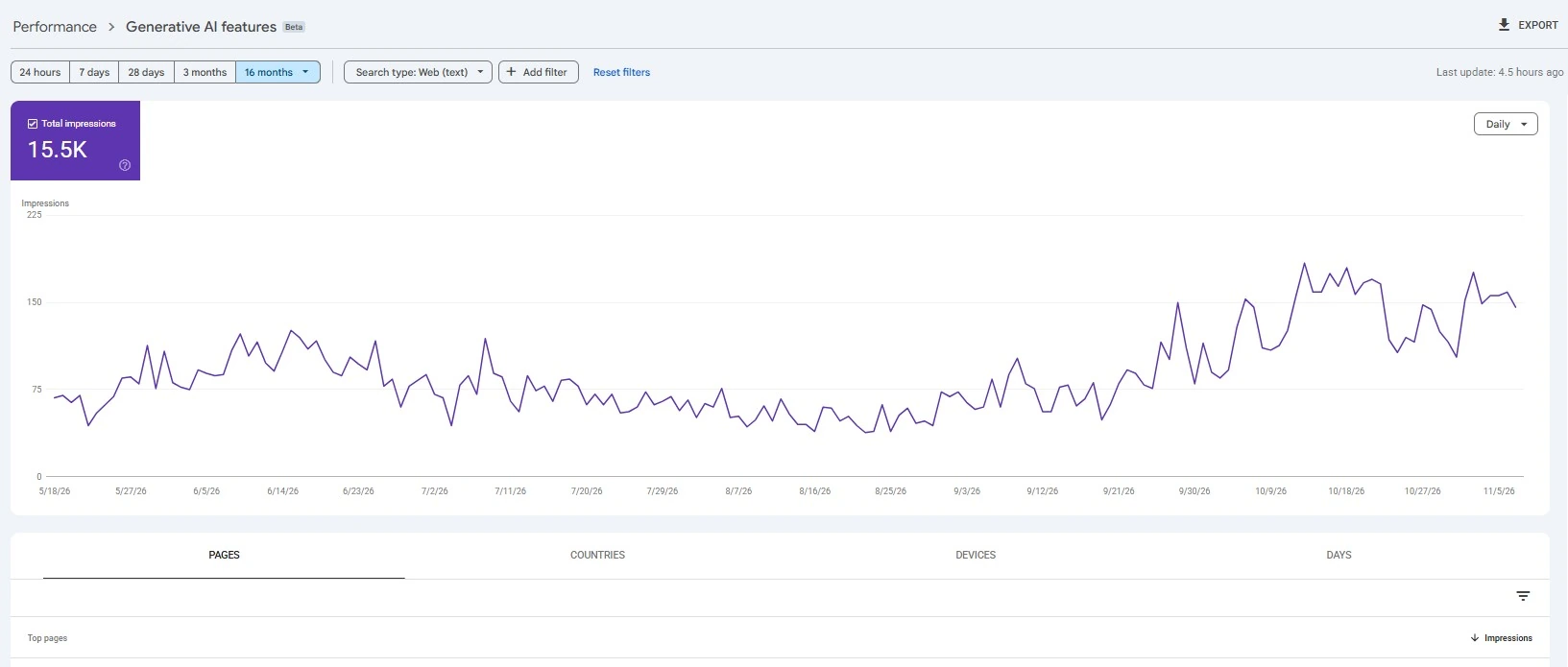
Since Google’s Generative AI Features report began on May 18, 2026, the website has generated 15,500+ Generative AI impressions, with daily AI visibility rising 206% between mid-August and early November 2026.
When we set Google Search Console’s Generative AI Features filter to the full 16-month view, the chart begins on May 18, 2026—the date Google’s report starts collecting data for every property. The site appeared in the report from the first day, and from its August low its daily impressions compounded rapidly as our relational schema, answer blocks, and HTML pricing table upgrades took effect:
- August 8 to 21, 2026: Averaged 51 generative AI impressions per day.
- September 2026: Climbed to 79 generative AI impressions per day.
- October 2026: Reached 136 generative AI impressions per day (peaking at 184 impressions in a single day on October 13).
- November 1 to 7, 2026: Averaged 156 generative AI impressions per day—a 206% increase over its August baseline.
In the 90-day page-level export (8,888 page impressions), nearly all generative AI impressions were captured by the five core page templates we restructured:
| Restructured Page Template | Generative AI Impressions (90 Days) | Share of AI Visibility |
|---|---|---|
| Primary Airport Corridor Service Page | 3,205 | 36% |
| Secondary Airport Transfer Hub | 2,009 | 23% |
| 246-Cell Plain HTML Rates & Pricing Matrix | 1,759 | 20% |
| Restructured Entity Homepage | 1,127 | 13% |
| Regional Airport Connector Page | 951 | 11% |
*(Note: Shares sum to slightly over 100% because Google Search Console counts property-level and page-level impressions separately when more than one URL appears in a single search session).*
What Can Other Businesses Learn From This Recovery?
- You do not need a backlink budget to recover rankings and win AI citations. When a client has no budget for link building, fixing technical index bloat, improving Core Web Vitals (LCP), and restructuring on-page content can double CTR and earn 47 AI citations even on a
DR 0.2domain. - Eliminate duplicate
-2slugs and image attachment pages immediately. Splitting authority across duplicate URLs and letting WordPress index raw media uploads leaves your business vulnerable to sudden visibility crashes. - Give each specific service and city its own dedicated page. Focused pages built around exact customer routes and service areas rank and get cited far faster than a single generic overview page.
- Deploy relational Schema markup that connects your pages and verifies E-E-A-T. Declaring page relationships, organization identity, and verified credentials gives AI systems the confidence to quote your business.
- Lead with 40-to-60-word Quick Answer Blocks, HTML pricing tables, and FAQs. Even as zero-click searches rise across Google, getting cited inside the AI answer puts your business in front of travelers early and sends high-intent visitors to your booking pages.
Frequently Asked Questions
The drop began on March 4, 2026, due to severe index bloat from duplicate -2 page trees, indexable raw image attachment URLs, a 45% 4XX crawl error rate, slow Core Web Vitals (LCP), and weak schema markup. Google’s late-March spam and core updates rolled out three weeks later, and these underlying technical flaws kept the domain suppressed until our mid-April index cleanup.
Because the client had no budget for link building, we focused 100% on technical SEO, Core Web Vitals speed optimization, canonical consolidation, dedicated service and city pages, relational JSON-LD Schema, E-E-A-T signals, 40-to-60-word quick answer blocks, and a 246-cell HTML pricing table. Impressions rebounded from 16 to 266 within 48 hours of our index cleanup and passed 1,500 per day within 12 days.
Yes. Despite holding a Domain Rating of just 0.2 in Ahrefs and building zero paid backlinks, this client earned 47 active citations across Google AI Overviews (39), AI Mode (3), Gemini (3), ChatGPT (1), and Perplexity (1). Clear on-page facts, relational schema, and Page 1 route rankings mattered far more than backlink volume.
Because this engagement covered on-page and technical recovery only, with no off-page work yet. The client came to us to recover the site and chose to prioritize that first. We offered a backlink project, but the client has not commissioned one yet. The gains above came without any link building, which leaves off-page authority as the untouched upside: a strong backlink profile built on top of this foundation is the next step to lift rankings and AI citations further.
Relational Schema markup that connects your pages and articles to one another (isPartOf, about, BreadcrumbList) while verifying your business identity (Organization, LocalBusiness, Service, FAQPage, author, publisher, and sameAs links) gives AI engines machine-readable proof of your E-E-A-T authority.
Before the recovery, thousands of impressions came from duplicate and junk URLs sitting on Page 3 to Page 5 that never earned clicks. By consolidating the index and adding quick answer blocks and HTML pricing tables, the site now ranks on Page 1 (Positions 6 to 7) for high-intent commercial searches—doubling its CTR from 1.43% to 2.92% and attracting higher-intent visitors.
Yes. We audit your Google Search Console data, index health, Core Web Vitals, and on-page structure, then engineer your core money pages and schema markup to win in both traditional Google Search and AI answer engines. You can book a Growth Strategy Session with our team or explore more of our research and case studies.
About This Case Study
Written and verified by MD Mizanur Rahman, Founder and Lead Growth Strategist at Invrse Marketing LLC. The client is a Southern California airport shuttle and private ground transport provider whose brand name and domain are kept confidential under our client agreement.
All performance data is verified from Google Search Console web search exports (July 8, 2025 to November 7, 2026), the Google Search Console Generative AI Features report (May 18, 2026 to November 7, 2026, when Google’s report data begins), and an Ahrefs site and AI citation audit taken on November 9, 2026.