
What is E-E-A-T and Why It’s Important for SEO in 2026?
Hundreds of websites lost 40-70% of their organic traffic overnight following recent Google core algorithm updates. The sites that survived—and the ones that grew—had invested deeply in E-E-A-T. They survived not because of technical errors, but because they couldn’t prove they were worth trusting.
If your search engine rankings feel fragile, or if AI-generated content is flooding your niche, this guide breaks down what E-E-A-T means and exactly how you can build it to secure your organic search visibility.
What Exactly is E-E-A-T?
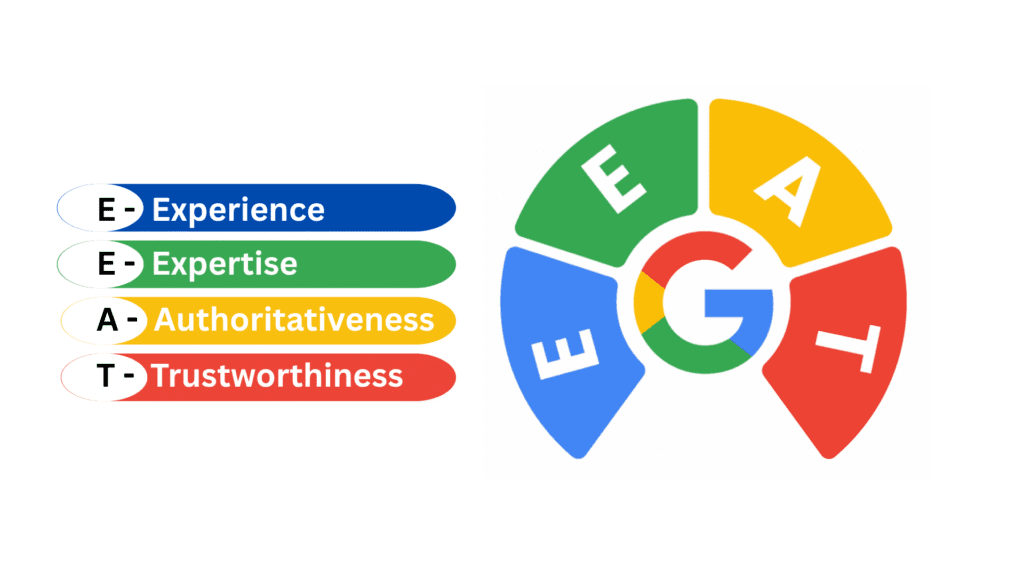
E-E-A-T stands for Experience, Expertise, Authoritativeness, and Trustworthiness. It’s the quality framework codified in Google’s official Search Quality Rater Guidelines—the document that trains Google’s human reviewers, whose assessments in turn inform its core algorithm updates.
The original framework was E-A-T until December 2022, when Google added the first “E” for Experience. In the era of mass AI-generated content versus human-written content, this addition has become the most consequential evolution in the entire framework.
Experience
Experience means first-hand, real-world involvement with the subject matter. Did the author actually use the product, visit the location, or navigate the process they’re describing? This is where humans have an irreplaceable edge over AI. Language models can synthesize information at scale, but they cannot hold an investment portfolio, recover from surgery, or build a business from scratch.
Expertise
Expertise is the depth of knowledge a creator brings to a subject. This includes formal credentials (licensed physicians, certified financial planners) but also earned, practical know-how—a mechanic with 20 years of hands-on experience carries real expertise, even without a formal degree. The key is that expertise must be demonstrable and verifiable through the content itself and the author’s digital presence. It cannot be just claimed in a bio.
Authoritativeness
Authoritativeness is your reputation as seen by others in your industry. It’s built through backlinks from high-authority, relevant websites, citations in industry publications, and recognition through media features. A personal finance blog cited in Forbes or linked by a major accounting firm carries significantly more authority than one operating in isolation—regardless of content quality.
Trustworthiness
Trust is the centerpiece of E-E-A-T. Experience, Expertise, and Authoritativeness are not ends in themselves—they are the building blocks Google uses to verify Trust. A site can demonstrate impressive credentials and still fail if it has unclear ownership, deceptive design patterns, or a history of inaccurate information. Without trust, the rest of E-E-A-T is merely cosmetic.
Why is E-E-A-T important for SEO in 2026?
E-E-A-T requirements now extend far beyond strict YMYL niches to virtually all competitive searches—e-commerce reviews, SaaS comparisons, how-to guides, and more. But in 2026, the search landscape has evolved beyond traditional search ranking. To survive and dominate, your content must satisfy the algorithms powering three distinct discovery engines:
- SEO (Search Engine Optimization): Google’s helpful content systems have become ruthless at distinguishing between content that merely looks expert and content that is expert. High E-E-A-T signals are now mandatory to secure and maintain traditional organic rankings against algorithm volatility.
- GEO (Generative Engine Optimization): With the dominance of AI Overviews (SGE) and AI search engines like Perplexity and ChatGPT Search, generative models synthesize answers from across the web. These AI engines heavily rely on E-E-A-T, scraping and citing data only from highly trusted, authoritative entities to avoid hallucinating false information.
- AEO (Answer Engine Optimization): Voice search and smart assistants don’t give users a list of options—they provide a single, definitive answer. To become that “one true answer” selected by Answer Engines, your brand’s Trust (T) and Authoritativeness (A) signals must be absolutely flawless.
The message is clear: whether a user is scrolling Google search results, chatting with an AI assistant, or asking their smart speaker a question, E-E-A-T is the ultimate currency that guarantees your brand’s visibility in 2026.
The Critical Connection Between E-E-A-T and YMYL topics
YMYL (Your Money or Your Life) refers to content with a direct impact on a user’s health, finances, legal standing, or safety. For these niches—medical advice, investment guidance, legal content—lacking E-E-A-T isn’t just a competitive weakness. It is a critical ranking hazard. A generic article on diabetes management written by “Admin” isn’t just unhelpful—it’s a liability that Google actively suppresses.
Is E-E-A-T a Direct Google Ranking Factor?
Technically, no—there is no single “E-E-A-T score” in Google’s SEO guidelines. But practically, yes. The signals that demonstrate E-E-A-T—named authors with verifiable credentials, original research, high-authority backlinks, positive brand reputation—absolutely influence search engine rankings. Ignoring E-E-A-T is like ignoring your credit score while applying for a loan: the score itself may be invisible, but it shapes every outcome.
How to Improve E-E-A-T
Building people-first content requires actionable steps. Here is how you can systematically improve your website’s trust signals.
1. Prove Your Experience with Real Case Studies
Replace generic information with documented proof of real-world work. Include original data from your own research—surveys, A/B tests, analytics screenshots—that AI-scraped content can never replicate. That specificity is exactly what Google’s quality raters are trained to reward.
According to Semrush’s 2025 Content Marketing Statistics, 78% of B2B marketers now incorporate case studies and customer stories into their campaigns. Furthermore, Semrush’s 2025 SEO guidelines emphasize that to stand out against AI-generated content, creators must deliver “net-new value” through original research, expert analysis, and real-world experience that AI cannot replicate.
Real-World Tip: Don’t just tell your audience a strategy works—show them. If you are an SEO agency, publish a “Traffic Autopsy” report complete with blurred-out Google Search Console screenshots showing exactly how you recovered a client’s traffic after a core update.
2. Showcase Expertise Through Transparent Authorship
The “Anonymous Admin” is dead. Publishing content under generic author names in 2026 is actively working against your rankings. Google builds and references specific author entities—it looks for named individuals with verifiable credentials, consistent digital footprints, and traceable professional histories.
Google’s Search Central Blog explicitly recommends utilizing robust structured data. Adding Person schema markup helps search engines connect a writer’s byline directly to their broader digital footprint (like their LinkedIn or specialized directory profiles).
Real-World Tip: Create dedicated “Author Pages” for every writer on your site. Link out to their professional Twitter/X accounts, LinkedIn profiles, and other authoritative sites where they have been published. The goal is to prove this is a real Subject Matter Expert (SME).
3. Build Topical Authority Across Your Industry
Topical authority is Google’s recognition of your site as a comprehensive, reliable source on a specific subject. You’re better off dominating 2-3 topics thoroughly than scattering content across 20 topics superficially. A cybersecurity firm writing about pet care doesn’t broaden its audience—it confuses Google about what it actually knows.
Studies from Ahrefs indicate that websites with dense topical clusters (a pillar page linked to multiple highly specific sub-topic pages) rank faster for competitive keywords, even with a lower overall Domain Rating (DR).
Real-World Tip: Conduct a topical gap analysis. If you sell project management software, don’t just write “What is project management?” Write about “project management for remote design teams,” “agile sprint planning,” and “resource allocation.” Interlink these cluster articles to your main pillar page to build a semantic web of relevance.
4. Keep Your Content Fresh and Updated
Content decay is a silent E-E-A-T killer. An authoritative article referencing outdated statistics or deprecated tools actively undermines your trustworthiness. Date-washing (changing a publication date without updating the content) is now detected and penalized by Google’s systems.
According to an internal analysis published on the HubSpot Blog, content typically experiences a significant drop in performance after 571 days. However, when HubSpot began historically optimizing their aging content—updating facts, improving SEO, and republishing—they grew organic views on those specific posts by an average of 106%.
Real-World Tip: Set a calendar reminder every 6 months to audit your top 20 performing pages. Update old statistics with the most updated data, replace broken links, and add a brief “Editor’s Note” at the top explaining what was updated to signal freshness to both Google and your readers instantly.
5. Highlight Customer Testimonials and Reviews
Third-party validation is one of the most powerful and underutilized trust signals available. Reviews on Google Business Profile, G2, Trustpilot, and industry-specific platforms build brand reputation in spaces Google actively monitors.
According to the latest BrightLocal Local Consumer Review Survey (2026), a staggering 97% of consumers read online reviews for local businesses. More importantly, 74% of consumers only care about reviews written within the last three months, proving that review freshness is just as critical as your overall star rating.
Real-World Tip: Don’t let your reviews just sit on Google. Embed dynamic widgets from Trustpilot or Google Business Profile directly onto your high-converting landing pages. Even better, actively collect and display video testimonials; they carry particular weight because they authenticate the genuine human experience behind the words.
6. Earn Backlinks from High-Authority Websites
Backlinks from credible, topically relevant sources remain one of the strongest Authoritativeness (A) signals in Google’s algorithm. A single link from a respected industry publication acts as an undeniable “vote of confidence” that a generic, isolated website cannot easily manufacture.
The impact of backlinks on search visibility is staggering. A massive recent study by Ahrefs analyzing over a billion pages found that 96.55% of content gets absolutely no organic traffic from Google, largely due to a complete lack of backlinks. Furthermore, Backlinko’s analysis of 11.8 million search results revealed that the #1 ranking result in Google has an average of 3.8x more backlinks than positions #2 through #10.
Real-World Tip: Stop sending generic cold outreach emails begging for links. Instead, lean into “Digital PR.” Run a small survey in your industry, compile the data into an infographic or a unique report, and pitch that original data to journalists and bloggers. High-authority sites don’t link to generic blogs, but they love linking to original research.
Conclusion
E-E-A-T isn’t a checklist or a one-time optimization. It’s a long-term commitment to being genuinely useful, transparently credible, and consistently authoritative. In 2026, the websites that win in organic search are not those with the most content or the most keywords. They’re the ones who have built real trust.
Start Improving Your E-E-A-T Signals With Invrse Marketing
Building genuine E-E-A-T takes strategy, consistency, and deep subject matter expertise—exactly what most businesses don’t have the time or resources to develop in-house while running their core operations.
That’s where Invrse Marketing’s specialized content Marketing services and professional SEO services come in. Led by founder MD Mizanur Rahman, we don’t just publish generic, AI-generated blog posts; we craft high-quality, E-E-A-T-focused content designed to prove your expertise and build undeniable trust with Google’s helpful content systems. From conducting deep research and highlighting your brand’s real-world experience to structuring pillar pages that establish true topical authority, our team produces the people-first content your business needs to thrive.
If your organic traffic is volatile, your competitors are outranking you, or you simply want to scale your content output without sacrificing quality, let our expert writers handle the heavy lifting.


Çalışmalarınızda başarılar dilerim, SEO ve Dijital Pazarlama ile ilgili yeni yazılarınızı bekliyorum.
Thank you for your nice command.