

How to Optimize Meta Ads for Maximum ROI
Meta Ads can deliver strong results, but only when the campaign is built around return, not just reach. Many businesses waste money on Facebook and Instagram ads because they focus on clicks, impressions, or broad targeting instead of sales efficiency. The goal is not to spend less at any cost. The goal is to get the highest possible return from a controlled budget.
If you want real sales $5 per day is often too low to generate enough data for proper optimization. A more practical starting point is usually $30 to $50 per day. That budget gives Meta more room to test audiences, placements, and creatives while helping the algorithm learn faster.
This guide explains how to optimize Meta Ads for maximum ROI using a practical strategy that works for small businesses, e-commerce brands, and service-based companies.
What Are Meta Ads and Why Do They Matter for ROI?
Meta Ads are paid advertisements that run across Facebook, Instagram, Messenger, and Meta’s partner placements. They allow businesses to reach targeted audiences based on demographics, interests, online behaviour, and previous interactions with a brand.
For businesses that want measurable growth, Meta Ads are useful because they offer:
- precise audience targeting
- flexible budget control
- conversion tracking
- retargeting options
- creative formats for different sales funnels
When set up properly, Meta Ads can help increase:
- online sales
- lead generation
- website conversions
- booking requests
- product enquiries
- return on ad spend
For maximum ROI, you need more than ad delivery. You need the right campaign objective, the right audience, the right offer, and the right conversion path.
Why $30 to $50 Per Day Is a Better Starting Budget
A very small ad budget can limit performance before the campaign has a real chance to work. If your daily budget is too low, Meta may struggle to collect enough data to identify who is most likely to convert. This slows learning and makes optimization less reliable.
Starting with $30 to $50 per day gives you a better base for:
- testing multiple ad creatives
- identifying top-performing audiences
- generating enough clicks and conversion signals
- improving delivery stability
- measuring cost per result more accurately
This does not mean every business must spend heavily. It means you need enough budget to let the campaign produce useful data. A campaign focused on ROI needs room to learn.
Set a Clear Goal Before Launching the Campaign
Before you create any Meta ad, define the outcome you want. Many campaigns fail because the goal is vague. If you want sales, the campaign should be built for sales. If you want qualified leads, it should be built for lead generation.
A strong goal should be:
- specific
- measurable
- realistic
- relevant to your business
- tied to a timeframe
For example, a better goal is:
Generate 25 purchases in 30 days at a target cost per purchase of $18 or less.
That gives you a clear benchmark for performance. It also makes it easier to decide whether to scale, pause, or improve the campaign.
Choose the Right Campaign Objective for Better Returns
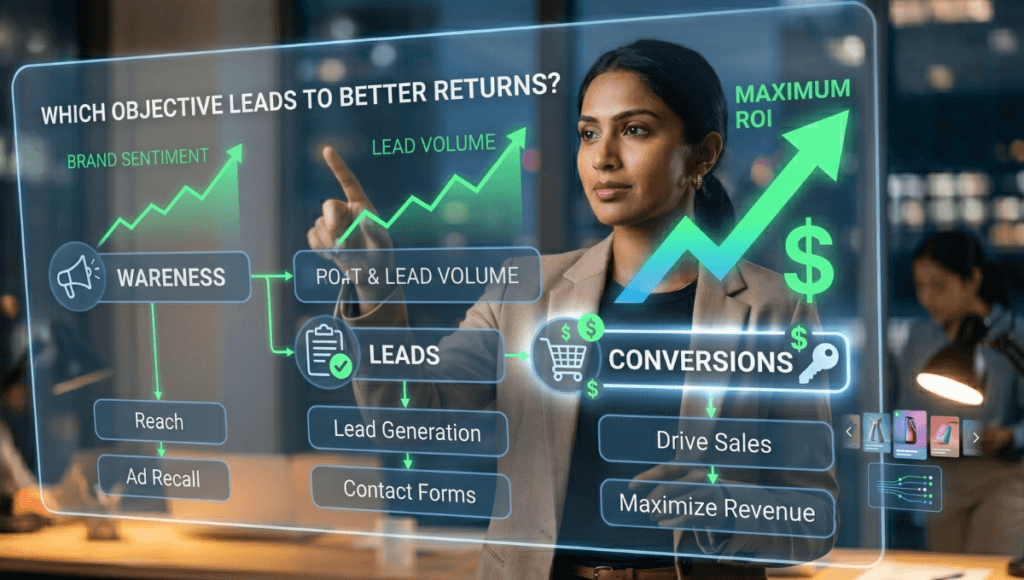
One of the most important parts of Meta Ads optimization is selecting the correct objective. Meta delivers ads based on the result you ask for. If you choose traffic, Meta will often find people most likely to click. If you choose sales, it will try to find people more likely to buy.
For maximum ROI, the best objectives are usually:
(i) Sales
Best for e-commerce, direct response campaigns, and businesses selling products online.
(ii) Leads
Best for service businesses, appointment-based businesses, and companies that convert leads through forms, calls, or consultations.
(iii) Engagement or Traffic
Useful in specific cases, but these should not be your default choice if your main goal is revenue.
If your business wants purchases, do not optimize only for cheap clicks. Cheap traffic does not always mean profitable traffic.
Build Better Audience Targeting Without Wasting Budget
Audience targeting has a direct effect on ad efficiency. If the audience is too broad, you may waste spend on people with low buying intent. If it is too narrow, your delivery may become expensive or unstable.
The best approach is to build audiences around intent and relevance.
(a) Use Warm Audiences First
Warm audiences often produce better ROI because they already know your business. These may include:
- website visitors
- people who added products to cart
- video viewers
- Instagram engagers
- Facebook page engagers
- past leads or customers
Retargeting these users often leads to lower acquisition costs and higher conversion rates.
(b) Use Lookalike Audiences
Lookalike audiences help you reach new people who are similar to your existing buyers or high-value users. This is useful when you want to expand beyond retargeting but still keep targeting quality high.
(c) Avoid Over-Targeting
Many advertisers narrow the audience too much by stacking too many interests and filters. This can reduce reach and drive up costs. Start with a strong audience theme, then let performance data guide further refinement.
(d) Use Geographic Targeting Properly
For local or regional businesses, geo-targeting matters. Show ads only where your service is actually available. This reduces wasted spend and improves lead quality.
Examples include:
- city-based targeting
- postcode targeting
- radius targeting
- regional targeting for delivery zones or service areas
This is especially important for local service businesses using Meta Ads for lead generation.
Use High-Intent Creative That Supports Sales
Ad creative plays a major role in ROI. Many campaigns underperform because the visuals are average and the message is unclear. Good creative should do one thing well: move the user closer to action.
Your ad should quickly answer:
- what you are offering
- who it is for
- why it matters
- why the user should act now
Best Performing Ad Formats for ROI
(i) Video Ads
Video ads are effective for product demos, problem-solution messaging, customer testimonials, and short educational content.
(ii) Carousel Ads
These work well when you want to show multiple products, benefits, use cases, or steps in a process.
(iii) Story and Reels Ads
These placements are often strong for mobile-first engagement and quick, direct messaging.
(iv) Static Image Ads
Simple image ads still work well when the headline, visual focus, and offer are strong.
For better results, keep your creative:
- clear
- visually clean
- mobile-friendly
- benefit-led
- easy to understand in seconds
Improve ROI With Better Ad Copy
Strong ad copy helps filter the right clicks. Weak copy attracts attention but not action. Your copy should match the audience’s problem, intent, and buying stage.
A stronger Meta ad message usually includes:
- a clear problem or pain point
- a practical solution
- a direct benefit
- trust or proof
- a strong call to action
For example, instead of saying:
We offer quality digital marketing services
say:
Need more sales from Facebook and Instagram ads? Our Meta ad strategy helps businesses improve ROAS with better targeting, creative testing, and conversion tracking.
This is clearer, more specific, and better aligned with user intent.
Set Up Conversion Tracking Correctly
You cannot optimize ROI if your tracking is weak. Meta needs accurate conversion data to learn which users are most likely to buy, book, or submit a lead form.
Your setup should include:
- Meta Pixel installation
- standard event tracking
- conversion-focused landing pages
- verified key actions such as purchases, leads, or bookings
If the pixel is missing or configured badly, the campaign may optimize for the wrong signals. That usually leads to wasted spend and poor performance.
Tracking is not optional. It is the foundation of profitable Meta advertising.
Optimize Landing Pages for Better Conversion Rate
A Meta ad does not create ROI on its own. The landing page completes the job. If users click but do not convert, the issue may not be the ad. It may be the page experience.
A high-converting landing page should have:
- a clear headline
- one focused offer
- strong message match with the ad
- fast loading speed
- simple layout
- trust signals
- a visible call to action
If your ad promises one thing and the landing page shows something else, conversion rate drops. Consistency matters.
This is where SXO becomes important. Search experience optimization is about making the full journey smoother, clearer, and more useful for the user.
How to Test Meta Ads Without Burning Budget
Testing is necessary, but random testing wastes money. A better strategy is to test one variable at a time and give each test enough data before making changes.
Start by testing:
- headline
- primary text
- creative angle
- audience segment
- offer
- landing page
Keep the process simple. If you change too many variables at once, it becomes difficult to know what actually improved the result.
For example:
- Test one offer against another
- Test video against static creative
- Test retargeting against lookalike targeting
- Test one landing page headline against another
The goal is not endless testing. The goal is controlled testing that leads to better ROI decisions.
Key Metrics to Monitor for Maximum ROI
To improve Meta ad performance, monitor the metrics that directly affect profit and conversion quality.
1. Return on Ad Spend (ROAS)
This tells you how much revenue you generate for each dollar spent.
2. Cost Per Purchase
This shows whether your sales are coming in at a profitable cost.
3. Conversion Rate
This measures how effectively clicks turn into sales or leads.
4. Click-Through Rate (CTR)
This helps indicate whether the ad is relevant and engaging.
5. Cost Per Click (CPC)
Useful, but do not treat it as the main success metric if your goal is revenue.
6. Frequency
A high frequency may indicate ad fatigue, especially if results start declining.
Do not judge campaigns only by clicks or impressions. Focus on business outcomes.
Common Meta Ads Mistakes That Hurt ROI
Several common mistakes reduce campaign efficiency and increase wasted spend.
a. Starting With Too Little Budget
A daily budget that is too low can limit learning and delay optimization.
b. Using the Wrong Objective
Traffic campaigns often bring low-intent visitors when the goal should be sales or leads.
c. Weak Creative
Poor visuals and generic messaging reduce engagement and conversion quality.
d. Bad Tracking Setup
If conversion tracking is inaccurate, Meta cannot optimize effectively.
e. Sending Traffic to a Weak Landing Page
Even a good ad fails when the landing page is slow, confusing, or poorly matched.
f. Scaling Too Early
Do not increase spend aggressively before finding a stable winning setup.
How to Scale Winning Campaigns Safely
Once a campaign is producing profitable results, scale with control. Sudden big budget jumps can disrupt performance.
A safer scaling approach includes:
- increasing budget gradually
- duplicating winning ad sets for separate tests
- expanding proven audiences
- refreshing creative when performance slows
- watching ROAS and cost per purchase closely
Scaling should follow proof, not hope.
Final Thoughts
If you want to optimize Meta Ads for maximum ROI, start with the right foundation. A realistic budget, clear objective, accurate tracking, strong creative, focused targeting, and a conversion-friendly landing page all matter.
For most businesses, $30 to $50 per day is a stronger starting point than $5 per day because it gives the campaign enough room to collect meaningful data and improve performance.
The best Meta ad strategy is not about chasing cheap clicks. It is about building a system that turns ad spend into measurable business growth.
Start Optimizing Your Meta Ads for Maximum ROI Today!
Don’t leave your ad spend to chance. Reach out to us for a personalized consultation and let us help you optimize your Meta Ads to drive real sales and improve your return on investment. Contact us now to get started!
Frequently Asked Questions–
Ques-1. What is the best budget to start Meta Ads for ROI?
Ans: For most sales-focused campaigns, $30 to $50 per day is a more practical starting point than $5 because it allows better testing and stronger optimization.
Ques-2. Are Meta Ads good for small businesses?
Ans: Yes. Meta Ads can work well for small businesses when the campaign is built around targeting, conversion tracking, and clear business goals.
Ques-3. What is the best Meta ad objective for sales?
Ans: The Sales objective is usually the best choice when the goal is purchases. For service-based businesses, the Leads objective may be more suitable.
Ques-4. Why are my Meta Ads getting clicks but no conversions?
Ans: This often happens because of poor audience quality, weak landing pages, unclear offers, or incorrect campaign objectives.
Ques–5. Do I need the Meta Pixel?
Ans: Yes. The Meta Pixel helps track actions on your website and gives Meta better data for optimization and retargeting.
Ques-6. Which Meta ad format is best for ROI?
Ans: There is no single answer, but video ads, carousel ads, static image ads, and retargeting ads often perform well depending on the offer and audience.
Ques-7. How long should I run a Meta ad before making changes?
Ans: Give the ad enough time to gather meaningful data. Making changes too early can interrupt learning and make performance harder to judge.