What Is E-E-A-T and Why It Is Important for SEO and AI Search
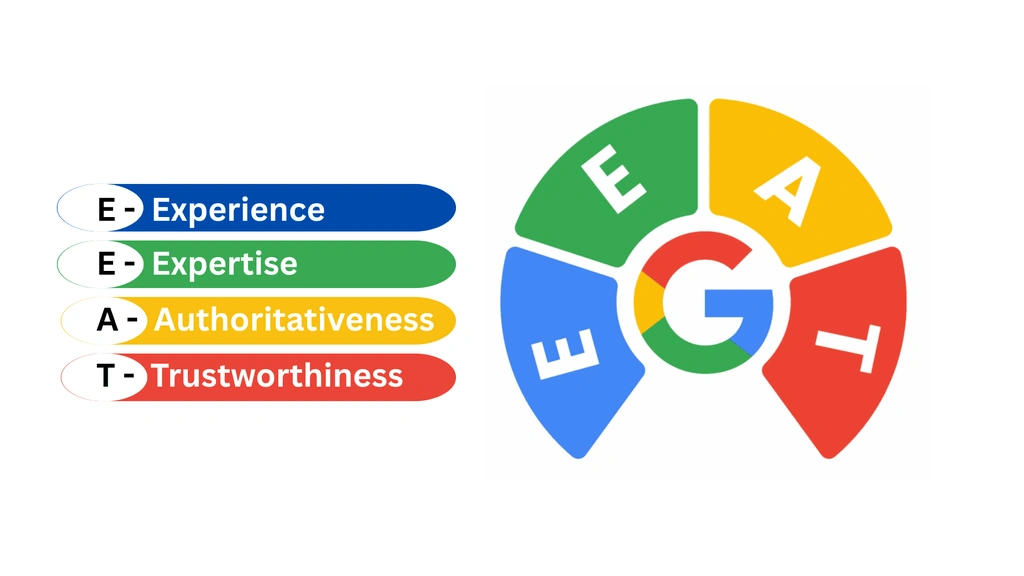
E-E-A-T stands for Experience, Expertise, Authoritativeness, and Trustworthiness, and you can think of it as the transparency signal of your business online. Defined in Google’s Search Quality Rater Guidelines, it measures how openly you show who runs your business, what they have actually built or done, and whether customers, search engines, and AI assistants can trust what you offer.
What Is E-E-A-T and How E-A-T Evolved Into E-E-A-T
At its core, E-E-A-T is not a complicated technical formula, but a simple measure of how open, honest, and real your business appears across the internet.
Think about how you evaluate a software product or service in real life. If a website hides who built the product, leaves its pricing vague, and has no customer feedback outside its own pages, you hesitate to buy. Search engines and AI systems face that same problem millions of times a day. They need a reliable way to separate real practitioners from anonymous websites making empty promises.
Google first introduced this concept in 2014 inside its Search Quality Rater Guidelines as E-A-T, covering Expertise, Authoritativeness, and Trustworthiness. In December 2022, Google added a second E at the start for Experience. Once generative AI made it easy for anyone to rewrite existing articles into textbook summaries in seconds, lived human experience became the clearest way to separate real practitioners from generic commodity content.
The Four Pillars of E-E-A-T and Why Trust Sits at the Center
Experience, Expertise, and Authoritativeness each prove a different part of your credibility, while Google places Trustworthiness at the center because none of the other three matter if a business is dishonest.
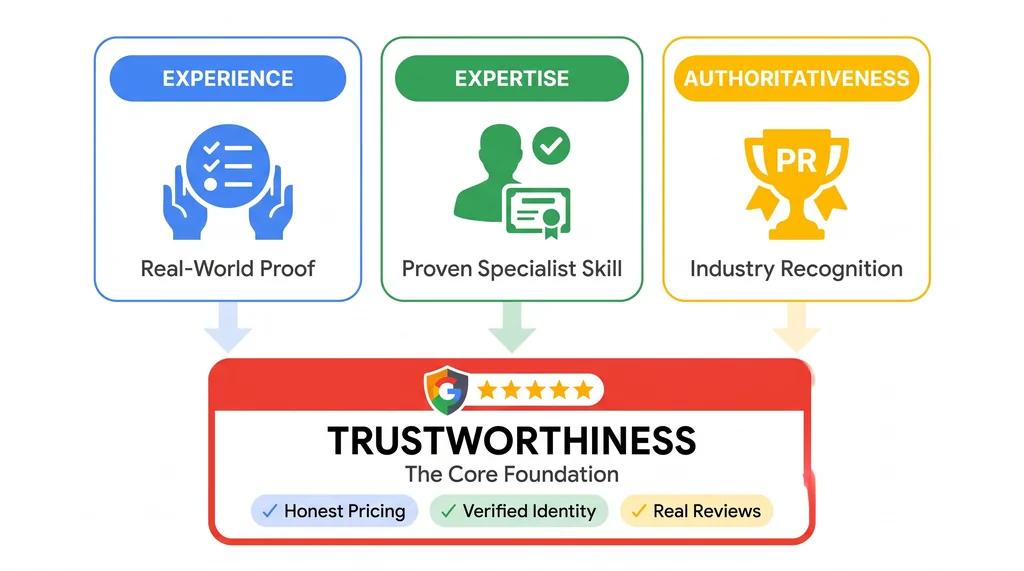
In its Search Quality Rater Guidelines overview, Google states that Trust is the most important member of the E-E-A-T family. The other three pillars exist to help readers, human reviewers, and automated systems judge how much trust your page and your business deserve.
Experience
Experience means first-hand, real-world participation in the subject you are writing about or the product you are offering. Writing about a product on your own blog is not enough on its own. When everyday users and creators talk about how your product works in real life, search and AI systems treat that as the strongest proof of experience.
Expertise
Expertise is the verifiable skill, formal training, or technical depth that a creator or founder brings to a topic. Depending on the subject, expertise can be formal, like a licensed attorney explaining business law, or practical skill earned through years of hands-on building. Even if a product is great, hiding the human builder behind a faceless brand keeps expertise signals weak.
Authoritativeness
Authoritativeness measures your reputation across your industry when other respected voices, publications, and platforms talk about your brand and founder. Today, authority is not just about how many backlinks you have. The specific context written around your name matters just as much.
Among the 50 mid-sized SaaS competitors we observed, one tool repeatedly won AI recommendations because an independent industry article comparing the 20 best tools in its category did not just drop a link. Inside the comparison table, the publisher directly described that product as one of the most powerful and accurate options available.
Trustworthiness
Trustworthiness is the accuracy, honesty, pricing clarity, and reliability of both your webpage and the business behind it. A business can have years of experience, a skilled founder, and press coverage, yet still fail if its pricing is confusing or its customer reviews are poor.
In our audit, one SaaS competitor stayed in almost every AI recommendation because it maintained consistent five-star reviews across Clutch, Product Hunt, and Trustpilot, while another won budget-focused searches because its pricing table was crystal clear. On the flip side, when a pricing table leaves plan boundaries vague, buyers purchase the wrong tier, feel misled, and leave negative reviews across the web.
| E-E-A-T Pillar | Core Question Being Asked | Where Proof Lives | What Weakens It Quickly |
|---|---|---|---|
| Experience | Have real people actually used or built this in real life? | Case examples, YouTube user tutorials, and Reddit discussions | Feature lists with no real-world context |
| Expertise | Does a skilled, identifiable human stand behind the work? | Founder and author pages, GitHub, and professional profiles | Faceless websites that hide who created the product |
| Authoritativeness | How do independent publications and lists describe you? | Contextual comparison mentions, Digital PR, and Knowledge Panels | Having zero recognition outside your own domain |
| Trustworthiness | Are your prices, plan limits, and customer reviews transparent? | Clear pricing tables and Trustpilot, Clutch, or Product Hunt reviews | Vague pricing tiers that confuse buyers and trigger bad reviews |
How E-E-A-T Works Behind the Scenes in Google Search and AI Search Engines
Behind the scenes, search engines and AI assistants connect your page content, your creator identity, and your off-site reputation to verify whether your business is safe to surface and recommend.
How Google Evaluates Content Creators and Websites Together
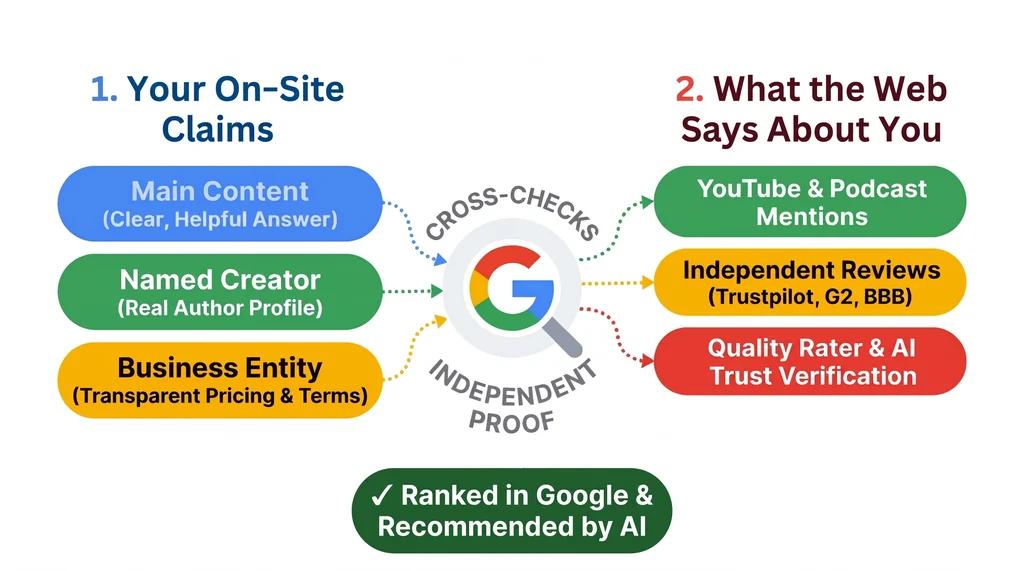
Google and AI tools never judge a single paragraph in isolation, because they evaluate the content, the creator, and the business behind the domain as one connected package. Inside Google’s Search Quality Rater Guidelines, evaluators check three layers together.
- The Main Content on the page. What is being said, how clearly it answers the question, and whether it shows original human effort.
- The Content Creator or founder. Who wrote or built it, and whether their real-world background matches the topic.
- The Website or business entity. Which company operates the domain, and whether its ownership, contact details, and policies are transparent.
What You Say About Yourself Versus What the Web Says About You
Search systems never take a website’s claims at face value, so they cross-check your pages against independent sources across the web. Anyone can call themselves the best on their own homepage. Both Google’s quality raters and AI tools check whether independent review sites, forums, and industry articles agree with your claims.
How Quality Raters Help Evaluate and Improve Google Ranking Systems
Human Search Quality Raters do not manually change live rankings for individual websites, because their evaluations are used to test and improve Google’s automated ranking systems.
As documented in Google Search Central’s helpful content guide, human raters review sample search results and assign two ratings. The first is Page Quality, which centers on E-E-A-T. The second is Needs Met, which measures how completely the page answers the searcher’s question. In March 2024, Google folded its Helpful Content System directly into its core ranking systems, using those human evaluations to help its algorithms separate trusted sources from low-effort pages.
How AI Search Engines Use Trust and Authority Signals to Choose Sources
While E-E-A-T is Google’s name for its quality rubric, AI search engines check the same real-world transparency signals when deciding which sources to cite and which brands to recommend.
When someone searches on Google AI Overviews, Bing Copilot, ChatGPT Search, Perplexity, Google Gemini, or Claude, the system uses a process called Retrieval-Augmented Generation (RAG). In simple terms, instead of relying only on old training memory, the AI searches the live web in the background to verify current prices, terms, and reviews before answering. When we tested those AI platforms with the exact feature requirements our SaaS client offered, the engines barely mentioned his brand at first, even though he ranked in Google search, because his off-site proof and founder signals were still disconnected.
What Our 50-Competitor Audit Revealed About E-E-A-T in Google and AI Search
When we audited 50 mid-sized competitors that were winning across traditional Google search, Google AI Overviews, and conversational AI search at the same time, their biggest advantage was a deeply connected founder and brand footprint.
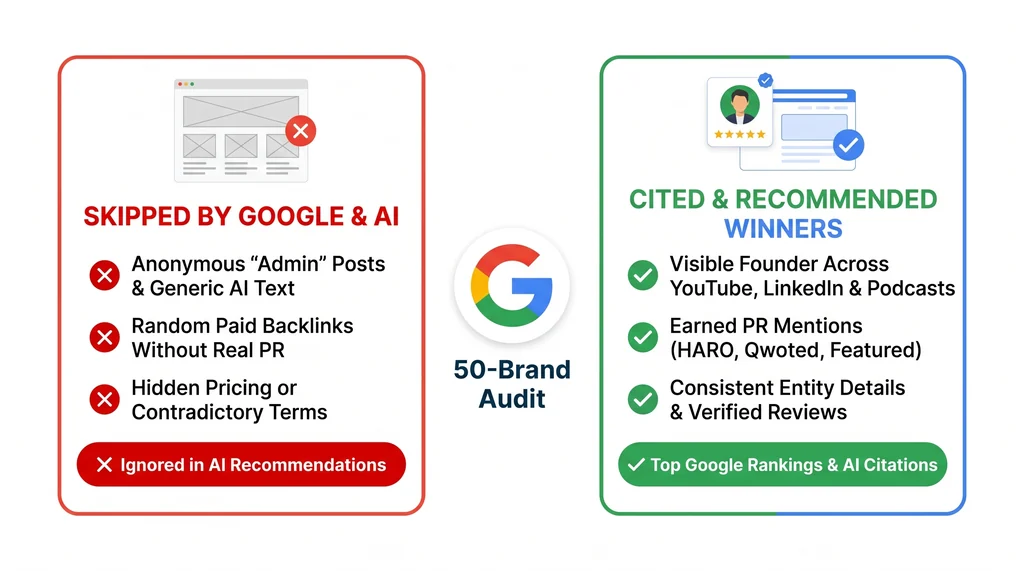
To see why certain smaller and mid-sized SaaS brands were consistently recommended across Google AI Overviews, ChatGPT, Perplexity, Gemini, and Claude, we skipped massive tech giants and audited 50 mid-range competitors with modest domain ratings. Beyond product tutorials and reviews, four deeper entity patterns stood out across those 50 companies.
- Digital PR built around real achievements rather than generic link drops. Instead of buying random guest-post links, top performers used journalist and expert platforms like Qwoted, Featured, and Connectively to share real company milestones, original data, and client outcomes that earned contextual praise in trade media.
- Visible founders active across podcasts and social channels. Behind the winning domains stood real founders who showed up regularly on industry podcasts, YouTube interviews, LinkedIn discussions, and niche forums, so third-party sites frequently mentioned the founder by name alongside the brand.
- Unlocked Google Knowledge Panels for 10 brands and 12 founders. Because their personal bios, company pages, podcast appearances, and press profiles all pointed cleanly to the same entities, 10 of the 50 companies had unlocked a Business Knowledge Graph panel (the information box Google shows for verified entities), and 12 founders or CEOs had unlocked a personal Google Knowledge Panel.
- AI and search recommendations even for subtopics missing from their websites. Most striking of all, because their off-site digital footprint made their core authority so clear, Google AI Overviews and conversational AI engines occasionally recommended several of these brands for closely related use cases that did not even have a dedicated landing page on their domains yet.
Why E-E-A-T Is Important for SEO, AEO, and GEO
E-E-A-T matters because it is the shared credibility filter across traditional search rankings, instant answer summaries, and conversational AI recommendations, protecting both your organic visibility and your paid ad spend.
When we first reached out to our March 2026 SaaS client, we offered to run Google Ads and social media ads. During our Growth Strategy Session, he explained why running paid ads right then would waste his budget. Whenever interested prospects checked Google or asked ChatGPT about his product, weak trust signals killed the conversion before they ever signed up. He needed to fix his organic trust and AI search reputation first while his team finished upgrading the product.
That is why E-E-A-T is essential across all three search channels.
- Search Engine Optimization (SEO). Pages backed by a transparent business and an experienced creator hold steadier organic rankings during major Google core updates.
- Answer Engine Optimization (AEO). Ranking in standard blue links does not guarantee a spot in Google AI Overviews or Bing Copilot answers, which pull concise 40-to-60-word answer passages from domains whose identity and facts are already verified.
- Generative Engine Optimization (GEO). Inside ChatGPT, Perplexity, Gemini, Claude, and Copilot, buyers ask directly whether your product or pricing tier is worth buying, and the answer depends on your founder transparency, pricing clarity, and independent reviews.
How E-E-A-T Connects to Your Money or Your Life Topics
Your Money or Your Life (YMYL) covers topics where inaccurate or untrustworthy information could harm a person’s health, financial security, safety, or society, prompting search systems to apply their strictest E-E-A-T standards.
Google’s Search Quality Rater Guidelines define four official YMYL categories covering health or safety, financial security, government, civics, and society, and other high-stakes life or consumer decisions. In our work with B2B and SaaS brands, we treat YMYL as a sliding scale rather than an on-off switch. Even if you sell software or business services rather than medical or financial advice, the moment a buyer asks an AI assistant whether your paid plan is worth their money, the system runs a strict trust check to protect the buyer from a bad purchase.
Is E-E-A-T a Direct Google Ranking Factor
No, E-E-A-T is not a direct ranking factor or a single numerical score inside Google’s code, but Google’s ranking systems measure real-world on-page and off-site signals that reflect E-E-A-T.
A computer can easily check whether a website uses HTTPS or loads fast. Human honesty cannot be measured in a single line of code. Instead, search and AI systems look at measurable proxy signals such as verifiable founders and authors, Google Knowledge Graph panels, transparent pricing tables, independent customer reviews, and mentions across respected websites.
For example, an Ahrefs study of 75,000 brands found that the more a brand is mentioned across the web, the more likely it is to appear in Google AI Overviews, showing a 0.664 Spearman correlation (a statistical measure where 1.0 is a direct match). While correlation is not causation, it shows how closely off-site reputation aligns with AI search visibility.
What Strong E-E-A-T Signals Look Like in Practice
In practice, strong E-E-A-T comes down to aligning three layers of proof across your content, your website, and your wider online reputation.
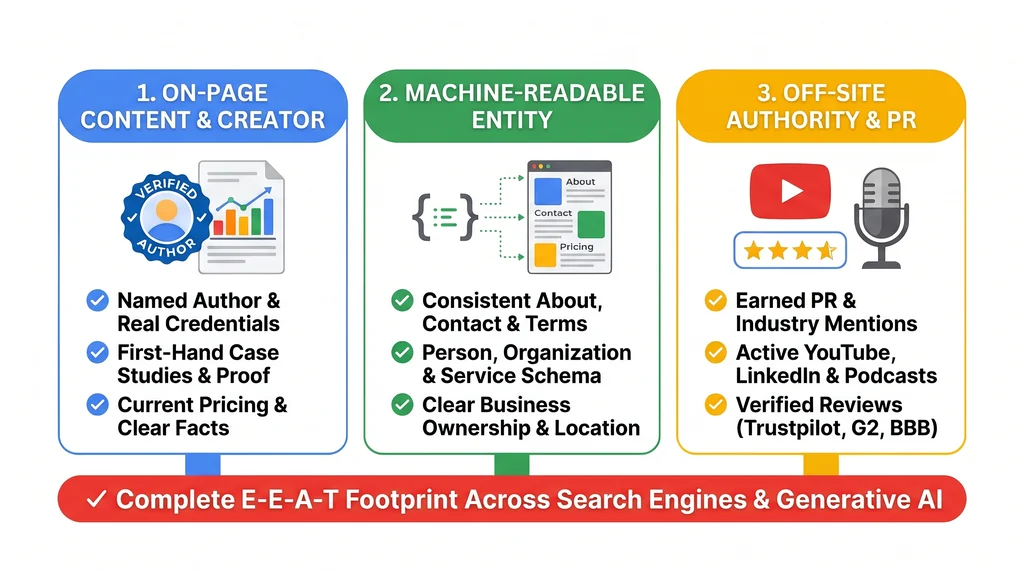
- On-page creator and content signals. Pages written or reviewed by named practitioners with verifiable credentials, real examples, primary source links, and current facts.
- Site-wide transparency and entity signals. Clear About, Contact, Pricing, and Terms pages that state consistent facts everywhere, backed by Person, Organization, and sameAs schema markup—an approach we proved in our 0.2 DR AI search recovery case study.
- Off-site reputation and authority signals. Contextual media mentions, podcast and community appearances by your founder, and consistent reviews on Trustpilot, Clutch, G2, Product Hunt, and the BBB.
To check where your brand stands right now, ask whether your founder identity is clear on your website, whether your pricing table leaves zero confusion, and whether independent reviews back up your claims. If you want a team to audit and strengthen how Google and AI search engines evaluate your business, founder MD Mizanur Rahman and the team at Invrse Marketing can help through AI Search Optimization, Content Strategy and Marketing, Search Everywhere Optimization, and Search Engine Optimization.
| Frequently Asked Questions
E-E-A-T stands for Experience, Expertise, Authoritativeness, and Trustworthiness. It is a standard in Google’s Search Quality Rater Guidelines used to judge how transparent and credible a webpage, its creator, and the business behind it are.
E-A-T was Google’s earlier three-part framework covering Expertise, Authoritativeness, and Trustworthiness, while E-E-A-T adds an extra E for Experience. Google introduced Experience in December 2022 so search systems would reward proof of real-world product use and direct human involvement over generic summaries.
AI can help organize a draft, but unedited, mass-produced AI content cannot show real human experience on its own. Strong E-E-A-T requires a real expert behind the page who shares first-hand examples, checks every fact, and takes accountability for accuracy.
Yes, E-E-A-T builds buyer trust in every competitive software and service category, not only health or finance sites. Whenever a buyer asks ChatGPT or Google whether your paid plan is worth buying, clear pricing boundaries, visible founder identity, and clean reviews decide the answer.
ChatGPT, Perplexity, and Claude do not use Google’s human raters, but their retrieval systems check the same kind of transparency signals. They cross-check your website’s pricing and founder identity against third-party comparison articles, YouTube tutorials, Reddit discussions, and review sites like Trustpilot, Clutch, and Product Hunt.
No SEO tool can output an official Google E-E-A-T score because E-E-A-T is a qualitative framework rather than one single metric. To track progress, watch real-world signals such as branded search growth in Google Search Console, whether your brand or founder has a Google Knowledge Panel, your review ratings, and how AI tools describe your business when buyers ask.