
What Is Retrieval Augmented Generation (RAG) in SEO and AI Search
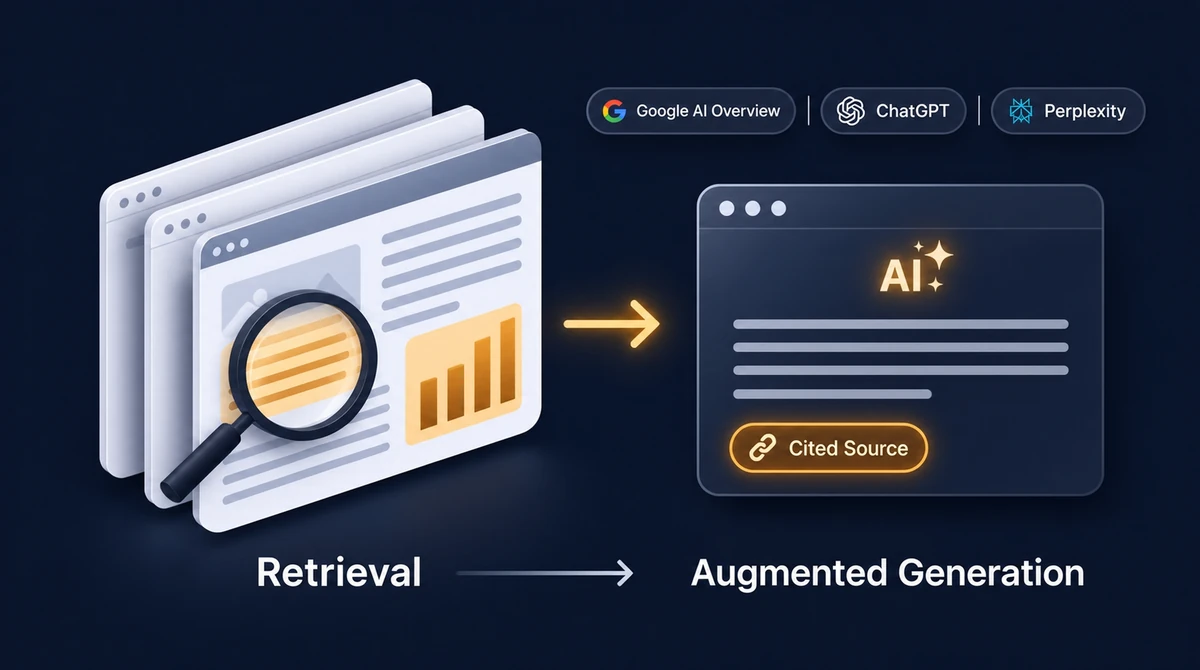
Retrieval Augmented Generation (RAG) is an AI framework that retrieves relevant information from external sources before a language model writes an answer. While a traditional search engine matches your query against its index and returns a list of webpage links for you to read yourself, a RAG-enabled system pulls relevant passages from live sources first and supplies them to a language model so it can produce a grounded, cited response.
Inside a RAG system, retrieval and generation handle two distinct jobs. The retrieval layer searches an index or knowledge base to gather candidate passages that match the user’s request. The language model then evaluates those retrieved passages against the user’s prompt and writes the final explanation. Although platforms like Google AI Overviews, ChatGPT Search, Perplexity, and Gemini each run their own custom search architectures, retrieval-augmented generation sits at the center of how modern AI search connects live web content to conversational answers.
What Is RAG in SEO and Why Does It Matter Now
A standalone language model only knows what existed in its training data up to a fixed cutoff date. When a buyer asks about current service rates, recent product changes, or a local company, an ungrounded model has to rely on static memory and can state outdated or fabricated facts with full confidence.
RAG addresses that problem by connecting the language model to an external search index at the moment a question is asked. Fetching live webpages lets the system verify current facts, reduce hallucinations, and display clickable source links alongside its answer. In its generative AI search guidance, Google explains that its generative AI features use retrieval-augmented generation, which Google also refers to as grounding in its Search index, to highlight current web pages.
Closed-Book Memory vs Open-Book Verification
A standalone language model works like a student sitting in a closed-book exam. Because the student can only draw on what they memorized months earlier, they might repeat an outdated statistic or fill in a gap with guesswork while sounding completely sure of the answer.

A RAG-backed search system works like a student taking an open-book exam with live reference materials on the desk. Before answering, the system looks up relevant pages, checks the specific facts on those pages, and cites the original URLs next to its explanation. For business owners and SEO practitioners, this means your live service pages, updated pricing tables, and research guides can influence AI answers as soon as they are indexed rather than waiting for an AI model to be retrained.
Why Even Million-Token AI Models Still Need RAG
Newer language models can accept hundreds of thousands or even millions of tokens in a single prompt, which leads some marketers to wonder whether retrieval is still needed. In reality, a large context window only works when you already know which documents to paste into the prompt. The open web contains billions of pages that change constantly, and no prompt can hold the live internet at once.
Stuffing huge volumes of unfiltered text into every prompt is also slow, expensive, and prone to attention loss. As both IBM Research and Anthropic explain, RAG acts as a high-speed filter that narrows a massive corpus down to the few specific passages the language model actually needs to read.
Want your core pages structured so search crawlers and AI retrieval systems can find, trust, and quote them? Explore our AI search optimization service to see how we build citation-ready pages.
How RAG Relates to Semantic Search and Traditional Keyword Search
RAG and semantic search are closely connected, yet they are not the same thing and do not always operate together. Semantic search is a retrieval method that matches queries to content based on meaning and context rather than exact word strings. Search engines have used semantic search for years to rank traditional webpage links even when no AI summary is generated.
RAG goes a step further by combining retrieval with answer generation. Within a RAG pipeline, semantic search plays a major role in finding passages that match the meaning of a user’s question, but it does not work alone. When a query includes an exact brand name, location, SKU, or technical error code, pure semantic search can miss the exact string, so RAG pipelines frequently pair semantic search with classic keyword matching before passing the winning passages to the language model.
- Keyword search matches exact words and phrases to return relevant documents or links.
- Semantic search matches underlying meaning and intent, whether for ranking traditional search results or feeding an AI retriever.
- RAG combines retrieval (often using both semantic search and keyword matching) with a generative language model that synthesizes the retrieved passages into a cited response.
Understanding this balance explains why AI search tools no longer evaluate your page like a simple keyword counter, yet still care about exact terminology. Across Google AI Overviews, ChatGPT, Perplexity, and Gemini, each platform uses its own retrieval mix, which is why building durable visibility across all of them requires search everywhere optimization.
How Retrieval Augmented Generation Works Step by Step
While every search platform builds its own proprietary retrieval stack, a typical RAG workflow in modern AI search can be understood through five illustrative stages. Each stage narrows the open web down to the specific passages that earn a place in the final answer.
| Stage | What Happens | Plain-English Purpose |
|---|---|---|
| 1 | Query understanding and fan-out | One complex prompt is expanded into several focused searches |
| 2 | Hybrid retrieval | Candidate pages are pulled using both exact terms and meaning |
| 3 | Embeddings and vector similarity | Passages are mapped as number vectors and compared for closeness |
| 4 | Passage selection and reranking | Self-contained passages are isolated and scored for direct relevance |
| 5 | Context window and grounded generation | Selected passages enter working memory so the AI writes a cited answer |
A note on what is public vs illustrative. Google publicly confirms in its documentation that its generative AI features rely on core Search ranking systems, RAG (grounding), and query fan-out. The specific mechanisms in Stages 2 through 4, including BM25 hybrid retrieval, vector embeddings, cosine similarity, and cross-encoder reranking, represent the standard information-retrieval architecture documented by AI research labs rather than a confirmed blueprint of any single platform’s private algorithm.
Step 1 Understand the Question With Query Fan-Out
Conversational search prompts rarely look like two-word keyword queries. A buyer usually asks a multi-part question comparing options, budgets, and use cases in a single sentence. To address every part of that request, many AI search systems run query fan-out, splitting the user’s prompt into multiple related searches that execute concurrently in the background.
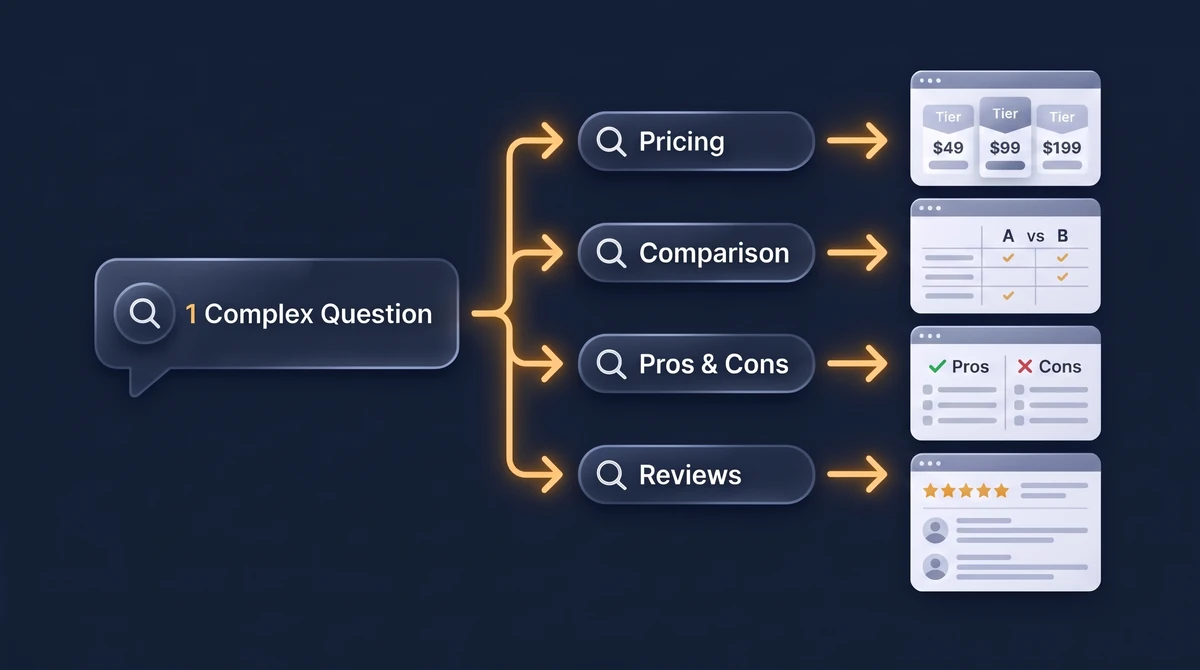
Google illustrates query fan-out with a homeowner asking how to fix a lawn full of weeds, which triggers parallel searches for lawn herbicides, chemical-free weed removal, and weed prevention. In our Answer Engine Optimization (AEO) research, a single complex query routinely branched into five to eight related sub-queries. Across 330 multi-turn buyer prompts in our Generative Engine Optimization (GEO) study, AI platforms ran more than 1,800 background searches to verify pricing, reviews, and service boundaries.
What this means for your website. A comprehensive page that answers a core topic alongside its natural follow-up questions gives retrieval systems relevant material for multiple fan-out queries in one place.
Step 2 Retrieve Candidates With Hybrid Search
Once those background queries run, a retrieval pipeline needs to pull candidate documents and passages quickly. Many modern RAG architectures use hybrid search, pairing two complementary retrieval methods so neither one leaves a gap.
The first method is lexical retrieval, commonly built on algorithms like BM25, which scores exact matches for words, brand names, model numbers, and technical terms. The second method is dense semantic retrieval, which uses vector embeddings to find content with the same meaning even when the wording differs. As Anthropic’s contextual retrieval experiments demonstrate, pure semantic search can miss an exact identifier like “Error code TS-999,” while pure lexical search misses helpful explanations that use synonyms. Combining both captures exact terms and broader meaning together.
What this means for your website. Include the exact industry terms, service names, and specifications your buyers type, and pair them with clear, natural explanations.
Step 3 Match Meaning With Vectors, Embeddings, and Similarity Scoring
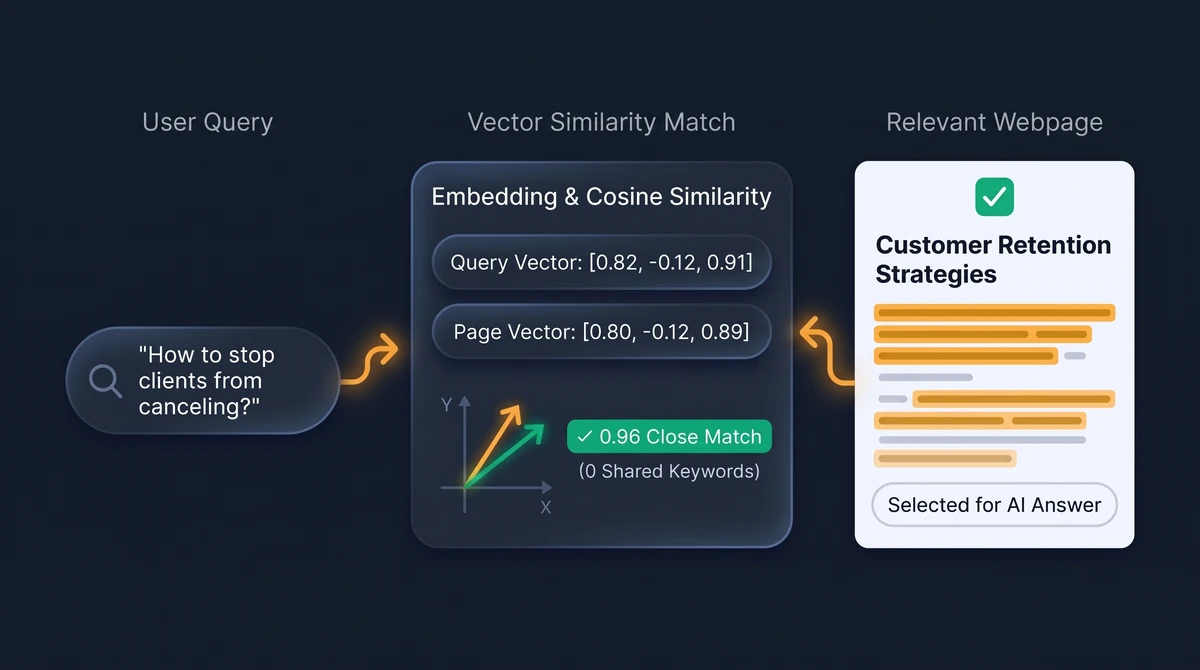
To compare meaning mathematically during dense retrieval, an embedding model converts text into a list of numbers called a vector. Those numbers act like coordinates on a multi-dimensional meaning map, allowing the system to measure how closely a passage aligns with a user’s query.
How Words and Passages Become Coordinates on a Meaning Map
Computers cannot interpret meaning from raw letters, so embedding models assign numerical coordinates to text based on how concepts relate in context. Picture a simplified two-dimensional map where related ideas sit near one another. On that map, “King” and “Queen” sit side by side because both represent royalty. “Monarch” lands in the same neighborhood, whereas “Elephant” sits far away in an unrelated corner.
Passages and sentences map the same way. A buyer searching for “how to stop clients from canceling” and a section titled “Customer Retention Strategies” share zero identical words, yet an embedding model places their vectors right next to each other because they address the exact same concept.
Why Real Embeddings Use Thousands of Dimensions
A flat two-number map makes the concept easy to picture, but production embedding models use hundreds or thousands of dimensions to capture subtle differences. Google’s Gemini Embedding 2 model, for example, supports flexible output dimensions from 128 up to 3,072, with 768, 1,536, and 3,072 recommended. At 3,072 dimensions, every encoded passage becomes an array of 3,072 numbers.
Imagine trying to tell two restaurants apart using only two numbers, price and distance. On that simple chart, a quiet sushi bar and a loud ramen shop on the same block look identical. Add hundreds of extra traits like cuisine style, noise level, seating layout, wait time, and lighting, and the two places become unmistakable. Embedding dimensions work the same way. Meaning is distributed across all dimensions together, allowing the model to separate a “river bank” from a “bank loan” without confusion.
How Passage Vectors and Page Context Work Together
In a RAG pipeline, systems typically create embeddings for individual passages or sections rather than compressing an entire 4,000-word article into a single vector, because one giant vector blurs specific answers. However, page-level context still plays a critical role. Search and retrieval engines use your page title, heading hierarchy, and surrounding topic focus to interpret what each passage refers to.
When every section on a page supports one coherent subject, both your page-level relevance and your individual passage vectors stay sharp. When a single page wanders across disconnected topics, individual passages lose their contextual anchor and become harder to retrieve accurately.
How Cosine Similarity and Vector Distance Measure Closeness
Once the query vector and candidate passage vectors are plotted, the retrieval engine calculates how close they are using a mathematical similarity metric. One of the most common metrics is cosine similarity, which measures the angle between two vectors (while other systems use dot product or Euclidean distance, which produce equivalent rankings when vectors are normalized).
Think of cosine similarity as a compass check. Draw an arrow from the center of the map to the user’s question, and another arrow to each candidate passage. When two arrows point in nearly the same direction, the angle between them is tiny and the score approaches 1. When they point in unrelated directions, the angle is wide and the score drops toward 0. On our map, “King” and “Queen” point almost the same way, while “Elephant” points elsewhere.
What this means for your website. You cannot view or edit vector coordinates or cosine similarity scores in an SEO tool, so your focus should be writing sections whose subject and meaning are unmistakable.
Step 4 Isolate Self-Contained Passages and Rerank
Even after initial retrieval narrows the web down to a shortlist of candidate passages, not every retrieved snippet makes the cut. Because feeding dozens of long webpages into a language model wastes compute and dilutes focus, many production RAG pipelines apply an additional relevance filter or a reranker (such as a cross-encoder model) that compares each candidate passage directly against the user’s prompt.
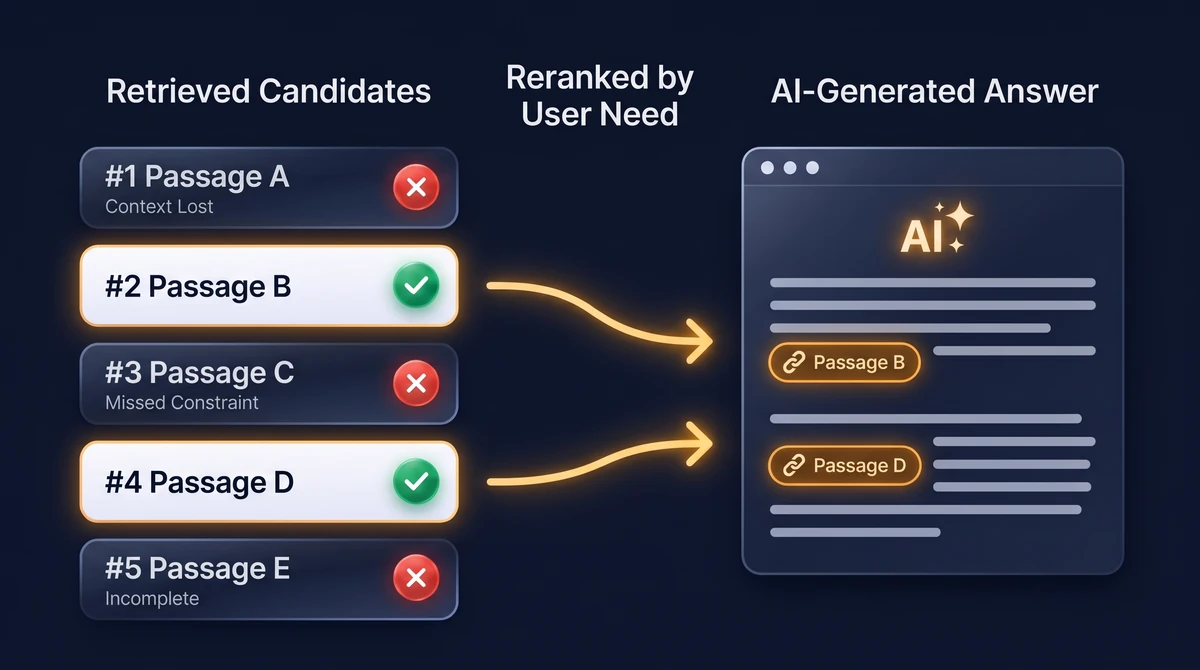
This stage exposes a frequent content failure called context loss. Suppose an extracted passage reads only, “The company’s revenue grew by 3 percent over the previous quarter.” Lifted out of the page by itself, that sentence fails because it never states which company or which quarter it describes. Anthropic’s contextual retrieval research showed that keeping explicit entity context attached to each chunk reduced retrieval failures by 49 percent, and combining contextual embeddings with reranking reduced failures by 67 percent.
Being retrieved into the candidate pool is very different from being cited in the final answer. In our GEO study of 330 buyer prompts, AI platforms evaluated roughly 15,600 retrieved source captures but cited only about 1 in 4 (roughly 3,800). The rest were dropped because they missed a specific constraint the buyer asked for. In our Gemini passage audits, over 80% of highlighted passages matched plain HTML text word for word, whereas key details hidden inside JavaScript tabs were far less likely to be extracted.
What this means for your website. Name the specific topic, service, or product inside every key section instead of relying on pronouns like “it” or “this,” and keep important facts in plain HTML.
Step 5 Assemble the Context Window and Write a Grounded Answer
In the final stage, the selected passages are placed into the language model’s context window alongside the user’s prompt. The language model synthesizes those passages into a cohesive answer and attaches source citations when supported by the platform.
How clearly you lead each section still affects whether your facts get used. The multi-university study Lost in the Middle demonstrated that language models recall information placed at the beginning or end of long contexts much more reliably than facts buried in the middle.
What this means for your website. Open each section with a direct, plain-English answer before expanding into supporting detail, so both human skimmers and language models capture your main takeaway first.
Traditional Keyword Search vs RAG-Powered AI Search
RAG does not replace traditional search engines. Instead, it builds an answer-synthesis layer on top of search retrieval. Comparing traditional keyword search with RAG-powered AI search clarifies why both page-level discoverability and passage-level clarity matter today.
| Dimension | Traditional Keyword Search | RAG-Powered AI Search |
|---|---|---|
| Query Handling | Matches the user’s single query against the search index | Often expands complex prompts into multiple background sub-queries |
| Retrieval Approach | Weighs keyword relevance, internal links, and backlink authority | Combines search index rankings with hybrid lexical and semantic retrieval |
| Primary Unit Used | Ranks the full webpage as a destination link | Evaluates page authority while extracting specific passages and tables |
| User Output | A ranked list of webpage links for the user to browse | A synthesized answer supported by source links and citations |
| Common Visibility Failure | Weak crawlability, thin content, or low domain trust | Buried answers, contextless paragraphs, or missing factual proof |
Where SEO, AEO, and GEO Fit as Optimization Disciplines
SEO, AEO, and GEO are not technical components inside a RAG software pipeline. They are the three practical optimization disciplines marketers use to make a website visible across each stage of a RAG-driven search experience.
- Traditional SEO builds index discoverability and page trust. Most web-connected RAG systems retrieve their candidate pages from established search engine indexes. If your site fails crawling, indexing, or quality standards under Google Search Essentials, it rarely enters the retrieval pool. Understanding how SEO works and maintaining a clean technical foundation through SEO services remains the prerequisite for AI search visibility.
- AEO improves passage clarity and extractability. Once a page is indexed and eligible for retrieval, Answer Engine Optimization structures headings, opening answers, lists, and HTML tables so individual sections remain clear when isolated.
- GEO strengthens brand verification and recommendation proof. When buyers ask conversational AI tools to compare vendors or recommend a provider, Generative Engine Optimization focuses on the verifiable pricing, case studies, and third-party reviews that give AI systems confidence to cite and recommend your business.
Retrieval Augmented Generation Examples in Everyday Search
Looking at two practical examples shows how retrieval and passage selection play out in real searches. The first illustrates a multi-requirement buyer query in a conversational AI assistant, while the second comes from our own Google AI Overview research.
Example 1 A Conversational Buyer Search in ChatGPT or Perplexity
Suppose a commercial property manager asks an AI assistant to recommend a commercial cleaning provider with transparent pricing for three downtown office buildings. Behind the scenes, the system searches for commercial cleaning service scope, per-square-foot pricing, and local downtown coverage.
Company A publishes a clear service section stating its starting rates per square foot, downtown coverage area, and contract terms in plain HTML text. Company B relies on generic brochure slogans and hides all pricing behind a contact form. When the retrieval system gathers candidate passages, Company A provides verifiable facts that directly answer the prompt’s constraints, while Company B offers nothing concrete to extract.
Example 2 Why Google AI Overviews Cite Clear Passages Beyond the Top 3 Links
In our 400-search Google AI Overview citation study, Google AI Overviews skipped 80.5% of the top three traditional organic results, and even the number-one organic result was bypassed 76.9% of the time. Those top-ranking pages often buried specific answers under long introductions or broad category grids, while lower-ranking Page 1 pages offered a direct, self-contained passage that matched a specific fan-out sub-query.
Consider two HVAC websites addressing how long a commercial rooftop inspection takes. Site A ranks first organically due to older backlinks, but opens with 150 words of company backstory before mentioning timing. Site B ranks fifth, places a clear heading on the page, and states the exact hour range in two sentences. Because the retrieval layer looks for the clearest supporting passage within the indexed results, Site B earns the citation.
What You Should and Should Not Do for RAG Visibility
Improving your visibility in RAG-supported search comes down to clear writing, complete topic coverage, and verifiable proof rather than technical gimmicks. Google Search Central states directly in its generative AI search guidance that you do not need to create llms.txt files, chop pages into artificial micro-chunks, or add special schema markup solely for generative AI features (while noting that standard structured data remains a good practice for overall Search rich results).
Write Clear Sections That Make Sense on Their Own
Writing self-contained sections satisfies Google’s people-first guidance while solving the exact context-loss problem documented in retrieval research. A simple editorial test is to read any H2 or H3 section by itself and ask whether a reader landing straight on that paragraph would immediately know the topic and get a complete answer.
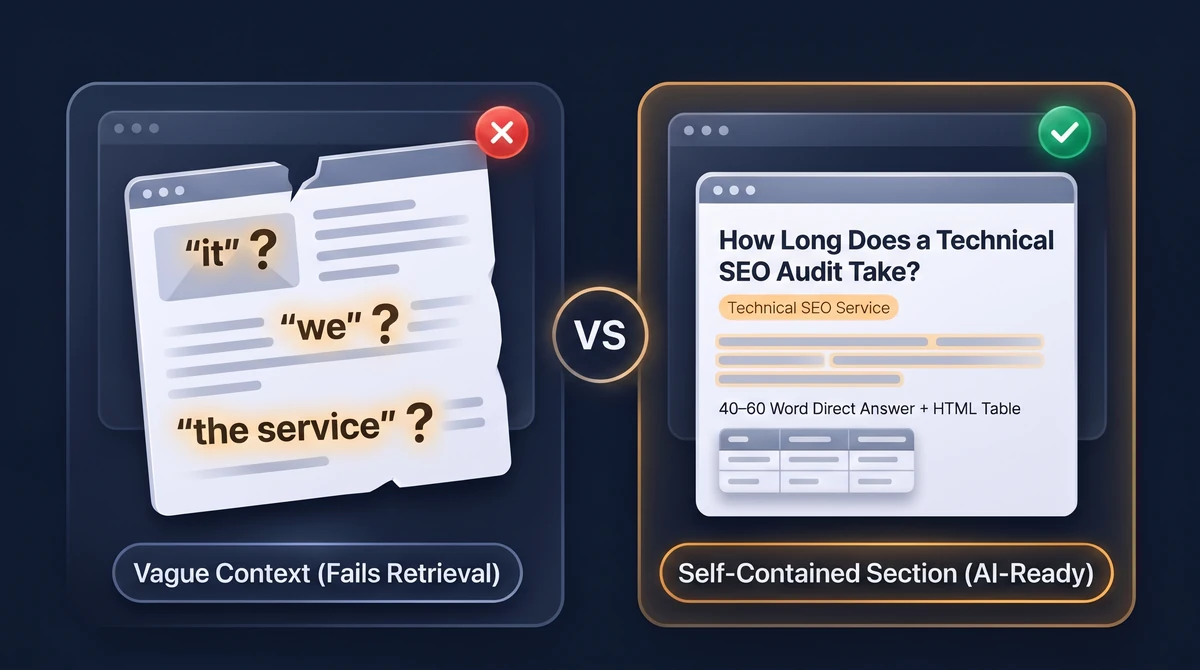
In our analysis of 1,100 AI citations, 32.1% of cited pages placed a direct 40 to 60 word answer immediately below a question heading, and another 27.2% presented data in clean HTML tables. Compare how a context-dependent passage reads against a self-contained one.
- Weak context-dependent passage. “It is our most popular package and usually takes about six weeks to see movement. Because of how we set it up, clients save a lot compared to doing it themselves.” Separated from the rest of the page, this passage fails because “it,” “we,” and “the package” have no named subject.
- Clear self-contained passage. “A technical SEO and site speed audit for a 50-page local service website typically takes two weeks to implement and four to six weeks to reflect in Google Search Console crawl and ranking reports. Fixing broken redirects, slow mobile templates, and duplicate service URLs helps crawlers index core money pages without wasting crawl budget.” This passage stands on its own for human readers and retrieval systems alike, matching the structure we used in our local transport recovery case study.
Make Your Meaning Easy to Match
While you cannot directly edit vector math or similarity scores, four writing habits make your content easier for hybrid retrieval systems to match.
- Name the specific subject, service, and location inside key sections rather than relying on pronouns.
- Use consistent terminology for core concepts alongside natural conversational phrasing.
- Answer natural follow-up questions on the same page so fan-out queries find complete coverage in one place.
- Keep pricing tiers, policies, and specifications in crawlable HTML rather than trapping them inside images or scripts.
Avoid the Query Fan-Out Spam Trap
Learning about query fan-out tempts some marketers to publish dozens of thin, near-duplicate pages for every slight question variation. Google explicitly warns in its AI optimization guide that creating separate pages for every query variation or fan-out query primarily to manipulate rankings or AI responses violates its scaled content abuse policy. One deep, well-structured guide consistently outperforms a pile of shallow pages.
Focus on Original Proof and Monitor Search Console
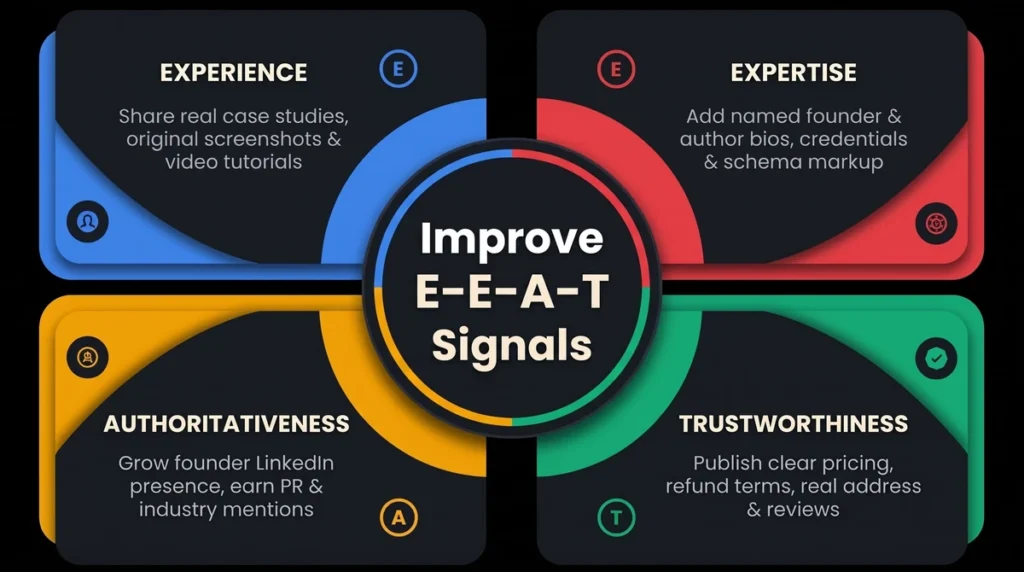
Any language model can summarize commodity definitions without sending traffic to your website. Pages that earn durable citations offer first-hand experience, original data, and transparent business terms. In our 66-business study on how to build strong E-E-A-T signals, the recommended business appeared in 196 of 198 live AI prompts compared with just 2 for the skipped competitor. All 33 recommended businesses published clear pricing tiers, rate ranges, or fee models, and all 33 stated plain-English refund, warranty, or cancellation terms.
Once your pages are indexed and structured, you can track how your site performs in Google Search’s generative AI features using the Generative AI performance report in Search Console.
Why Semantic SEO Is the Next Step After Understanding RAG
Understanding how RAG retrieves information points directly to the next step in your content strategy. Because retrieval engines evaluate meaning across complete sections while Google penalizes thin fan-out pages, the most effective approach is Semantic SEO, building comprehensive, entity-rich pages that cover a core topic and its related sub-questions in one authoritative resource.
Our next guide will show you step by step how to plan and write semantically optimized content for your website. If you want an experienced team to build that foundation for you today, explore our AI search optimization and content strategy and marketing services.
Frequently Asked Questions About RAG in SEO
Is RAG the same as AI search?
No. AI search refers to the user-facing experience, such as Google AI Overviews, ChatGPT Search, or Perplexity. RAG is the underlying retrieval-and-generation framework that many AI systems use to pull external information and ground their answers in live sources.
Does traditional SEO still matter if AI platforms use RAG?
Yes. Web-connected RAG systems rely on search engine indexes to find candidate pages. If a page cannot be crawled, indexed, or trusted in traditional search, it rarely enters the retrieval pool. Strong SEO earns your place in the index, while clear, verifiable passages help your page get referenced.
Do I need to break my content into small chunks for RAG and AI search?
No. Google explicitly states in its AI optimization guide that you do not need to break your content into tiny pieces for AI systems. Writing for human readers with logical headings and clear, self-contained paragraphs supports both reader comprehension and automated passage retrieval naturally.
Why does AI sometimes cite a page that ranks lower?
Organic page rank and passage-level retrieval relevance are not identical. When an AI system runs background fan-out queries, a lower-ranking Page 1 result with a direct, evidence-backed answer under a clear heading can satisfy a specific sub-question better than a top-ranking page that buries the detail.
Can I measure or control cosine similarity scores for my webpages?
No. Cosine similarity is one of several internal mathematical methods (alongside dot product and distance metrics) that retrieval systems can use to compare query and passage vectors, and vector dimensions such as the 128 to 3,072 range in Gemini Embedding 2 are defined by the model. Because no SEO tool can view or adjust those internal scores, focus on clear headings, explicit entity names, and thorough topic coverage.
Does hallucination disappear with RAG?
No. RAG reduces hallucinations by grounding the language model in retrieved external sources rather than relying solely on training memory. Even so, a model can still misinterpret an ambiguous passage or draw from a weak source, which is why plain HTML and unambiguous facts matter.
What is the difference between RAG and fine-tuning an AI model?
Fine-tuning trains a model on additional examples to adjust its tone, formatting, or specialized behavior. RAG leaves the base model’s training weights unchanged and supplies it with live, citable information from external sources at the moment a user asks a question.
How can I check if my content is ready for RAG?
Review your core pages section by section to verify that each major block names its subject explicitly, opens with a direct answer, and presents pricing or key facts in plain HTML. Alongside manual prompt checks in AI search tools, you can monitor your impressions and clicks from Google Search’s generative AI features using the Generative AI performance report in Search Console.